
It's Tuesday June 9, 2026
April 5, 2008
When it rains, it stores.That’s the idea behind the many rainbarrels you may soon be seeing in the area. Forty of them went home with Oriental-area residents after NC State’s Cooperative Extension Service held workshops at Town Hall on Friday.
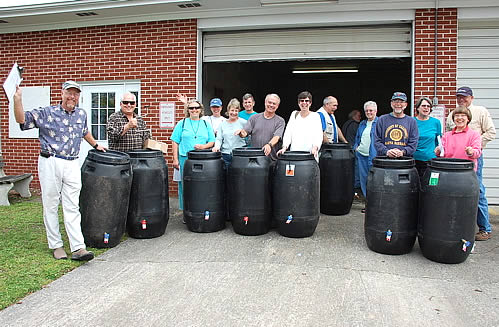 Barrels rolled out. Some of the new rainbarrel owners.
Rainbarrels have been in great demand in the past year, because of the drought in North Carolina. Charlie Humphrey, environmental education coordinator with the Craven County Agricultural Extension Service, says he used to be able to get the barrels themselves for free from sources such as Mt. Olive pickle company, or soda bottlers. Now, because of the rainbarrel revival, there is a 6-8 week wait, and a 5-10 dollar pricetag per barrel.
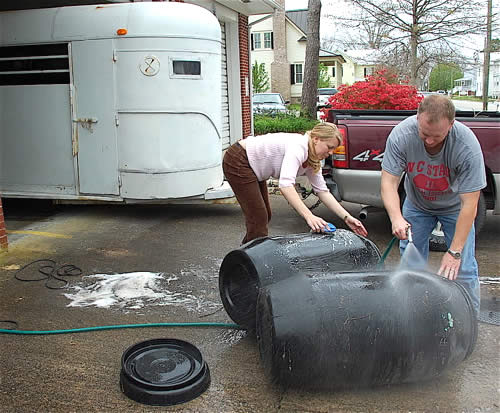
Charlie Humphrey and Amy Andrews with the Cooperative Extention Service brought the 40 barrels to Town Hall in a horse trailer on Tuesday and spent a few hours cleaning them.Friday’s workshop at Town Hall evolved from a talk Humphrey gave in Oriental earlier this winter about creating rain gardens to capture stormwater runoff. In low-lying parts of town where small ponds form naturally after a rain, rain barrels seemed like they could be of even more use, by saving up water to use later.
The possiblity of a workshop was floated here at TownDock, and response was great. Dozens of people attended Friday. And many more rainbarrels would have sold had there been a bigger supply.
(One feature that made the rainbarrels so sought after was their price: $35. Some participants said they’d seen commercially-made rainbarrels selling for three and four times as much.)
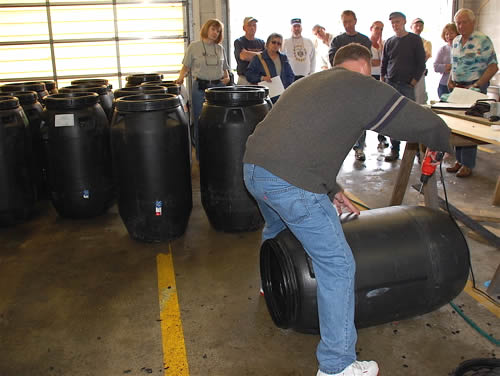 Charlie Humphrey drills a hole for a spigot.
Charlie Humphrey, along with Daniel Simpson of the Pamlico Extension Service Office made most of the rain barrels before the workshop began. But they demonstrated how folks could make them themselves with not much more than a drill, a spigot, some washers and screening.
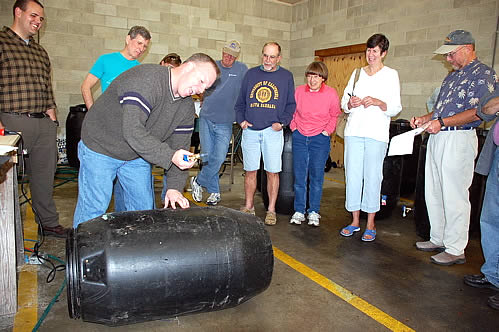 And then the spigot is attached, though sometimes not very easily.
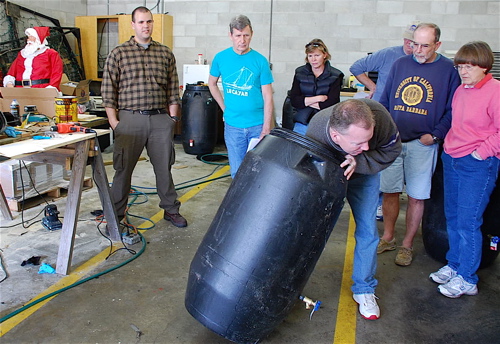 Some of the fittings have to be tightened from the inside.
[page]
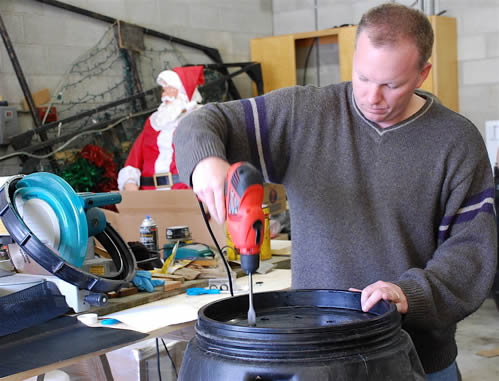 Then, there was the matter of letting water in to the barrel. Charlie Humphrey uses a drill to punch holes thru an inner lid. (The workshop took place in the workshop area of Town Hall, where Santa spends much of the year.)
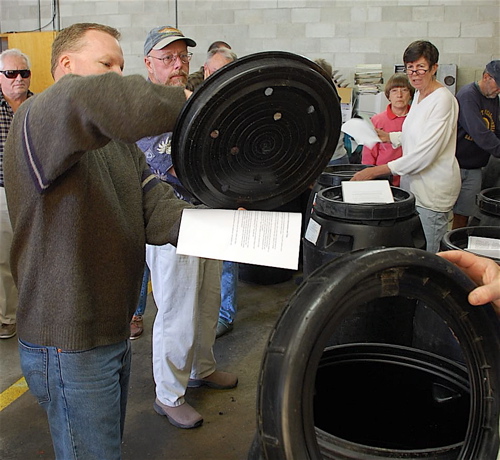 Holes drilled, but it’s not quite finished yet.
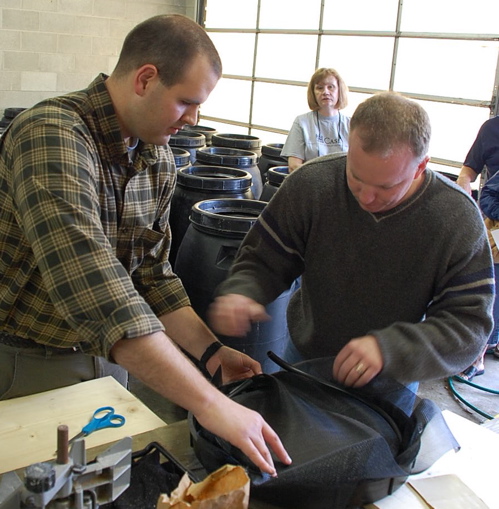 Daniel Simpson of Pamlico’s Cooperative Extension office helps to fit screening that will keep mosquitos and debris out of the water.
Some of those taking part in the workshop said they liked the idea of capturing rain that would otherwise become stormwater runoff. Others anticipated savings on the water bill. And one couple hoped for healthier plants that had been hurt by chlorinated tap water.
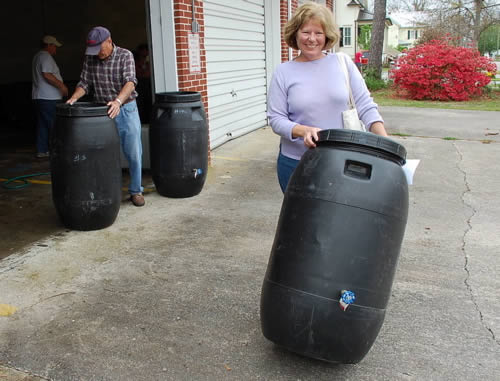 Leslie Surma with her new rainbarrel. In background, Frank Fitzpatrick.
At the end, workshop attendees were rolling or hoisting their barrels to trucks — most cars wouldn’t fit them. But as large as the barrels appear, Charlie Humphrey said that once installed at the end of a gutter pipe, they would fill quickly. Two-tenths of an inch of rain falling off a 500 square foot roof will fill a 60 gallon barrel, he said. (The rule of thumb is 1 inch of rain on 500 square feet = 300 gallons.)
Some residents say they’d like to install a series of several rainbarrels so that one could take the overflow from another. The trick, right now, is to find empty barrels to do that.
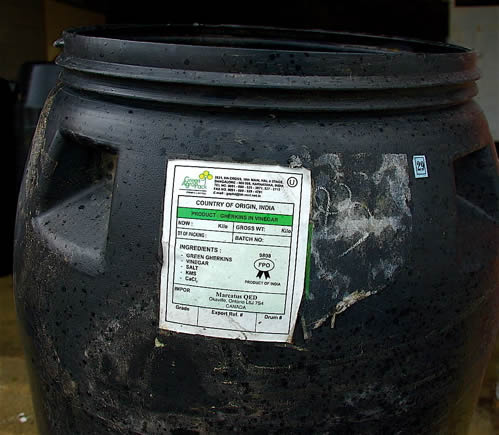 At least some of the barrels were made in Bangalore and were initially used to ship gherkins from India to the Mt. Olive pickle plant in NC.
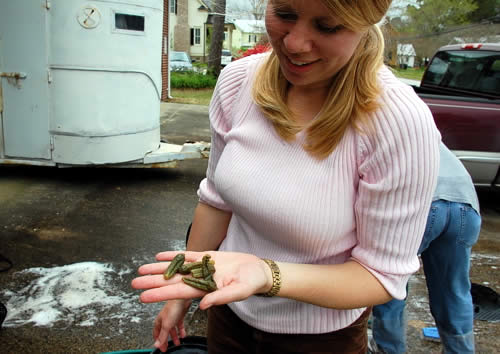 Amy Andrews with the Cooperative Extension Service found a few left-over gherkins in the barrels while cleaning them out earlier this week.
If you can’t wait for an empty gherkin barrel from Mt. Olive, Charlie Humphrey says a thick-walled plastic garbage can would work, too. While costlier than the relatively cheap pickle or syrup barrels from soda bottlers it may be less expensive than the factory-made rainbarrels.
Posted Saturday April 5, 2008 by Melinda Penkava

 • May 2026 - The Pig Celebrates 10 Years • May 2026 - NOAA's Prediction: A Below Average Hurricane Season • April 2026 - Cycle NC 2026 • April 2026 - April Town Board Meeting 2026 • April 2026 - Zac Schnell, AI and Community Engagement • April 2026 - The 2026 Oriental In-Water Boat Show • April 2026 - Eston “Sherrill” Styron, 1942 - 2026 • April 2026 - Capsizing on the Creeks: SailPack 2026 • April 2026 - 2026 PAWS Pet Parade • March 2026 - The Dragon Burn That Didn't • March 2026 - James "Jimmy" Edward Ragan, III, 1941 - 2026 • March 2026 - March Town Board Meeting 2026 • March 2026 - Loblolly Pines & Pollen • March 2026 - Russell "Russ" Bryan Stevenson, 1932 - 2026 • March 2026 - Town Board Acts Fast in Fight for Funds