
It's Tuesday June 9, 2026
July 16, 2010
Shrimp trawlers were rafting up four and five deep across Oriental’s harbor before noon on Friday, their holds full of Pamlico Sound shrimp which the crews were unloading at the docks of Garland Fulcher Seafood. The seafood plant is expecting to take in — literally — at least 15 boat loads by Saturday.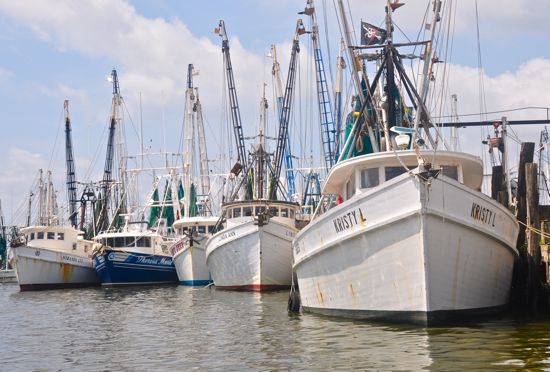 Oriental’s harbor just before noon on Friday. By law trawlers have to have nets out of the water by sunset on Friday, but shrimp were so plentiful this week, that many trawlers were lined up even on Thursday to get their catch unloaded.
The early reports are that the trawlers are finding bigger shrimp this week than last, which will come as good news for people who’ve been waiting for the arrival of locally-harvested freshly-caught crustaceans. However, the news may be mixed for the boat captains.
When the shrimp season started a few weeks ago, the thinking was that the Pamlico Sound shrimp might be fetching a better price than they did last year. Mike Styron of Garland Fulcher Seafood, which buys the shrimp from the trawlers, says that, “With the Gulf oil spill, we were assuming that the shrimp price would be high this year.” That seemed a reasonable expectation since there’d be less competition as many shrimp boats in the Gulf of Mexico were not fishing because of the oil-damaged waters.
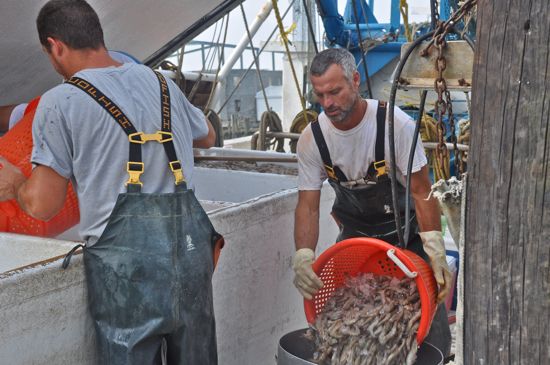 On Thursday morning, the trawler, San-Dia out of McClellanville, South Carolina had a cargo hold full of shrimp that the crew had gathered since Sunday. At left, Oriental native Clint Belangia who works on the South Carolina-based trawler, and at right, fellow crewmember, Shawn White who pours a basket of shrimp in to a waiting metal bucket next to the dock at Garland Fulcher Seafood.
But word on the docks in Oriental on Thursday was that instead of the economics of shortage and demand kicking in to gear, there’s another factor in play: the compensation package that British Petroleum has been paying out.
Mike Styron says BP was paying compensation not only to the Gulf shrimp trawlers idled by the spill, but also to the big shrimp processing plants along the Gulf. Those are the plants where Garland Fulcher Seafood has, in other years, sent its smaller shrimp, the ones that consumers might not want to be bothered with peeling in a shrimp boil.
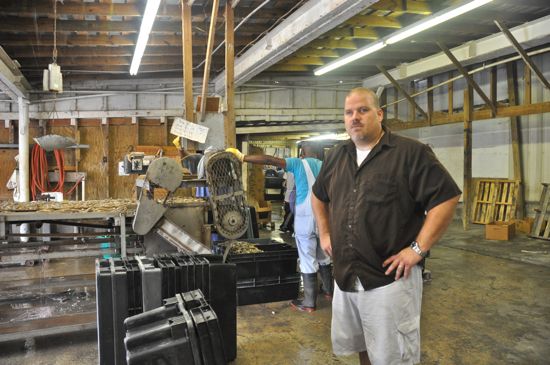 Mike Styron, at Garland Fulcher Seafood in the room where the shrimp comes in off of the boats.
Because the Gulf processing plants are taking the BP money, they are not as motivated to buy the small shrimp from here, says Mike’s father, Sherrill Styron, who owns Garland Fulcher Seafood. The BP disaster, says Sherrill Styron, “hurt us instead of helped us.”
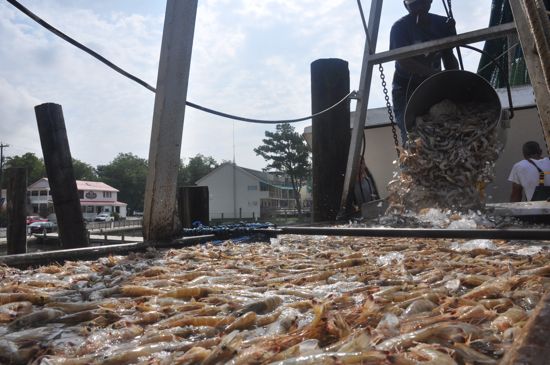 Just seconds off of a trawler, shrimp on its way in to Garland Fulcher Seafood..
Sherrill Styron says that while there is demand for the larger shrimp — the ones that weigh in at 16-20 or 21-25 or 26-30 per pound — a sizeable proportion of the shrimp still being trawled in the Pamlico Sound has been smaller than that. Being unable to send the small shrimp to the Gulf processors, Sherrill Styron has to weigh whether it’s economically feasible to freeze and store it here for processing at a later date.
That calculation goes in to determining the price the captains get.
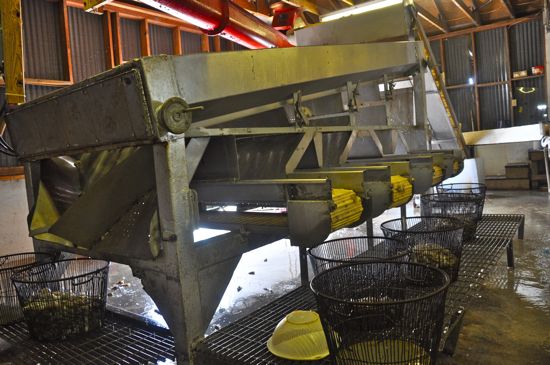 Size matters. The sorter at the seafood plant divides the shrimp by size. While the larger shrimp are in demand, the smaller shrimp less so. The small ones are usually sent to processing plants on the Gulf, but they are not motivated to buy them now as they are receiving compensation from BP for the oil disaster that shut down shrimping in that area.
[page]
This week the economics of BP’s compensation package is a factor, but as happens with fishing, the situation could change markedly in coming weeks. Shrimp do get bigger as the season moves on in to late July and August and if the trawlers bring in that size shrimp, they have a ready market that doesn’t require processing at a plant on the Gulf.
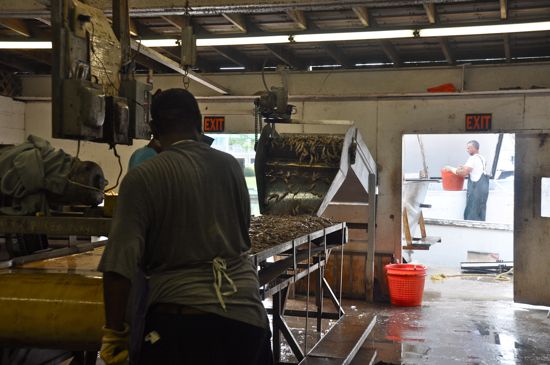 The shrimp coming in to the plant from the trawler, San-Dia, with crewmember Shawn White in background on the boat’s deck. Getting shrimp ready for market is labor intensive. Even after the shrimp are hauled on to the boats, the work is physical: lifting up baskets, hauling buckets, nimbly removing the heads off shrimp.
Looking ahead, in September, a new season of shrimping begins, with the mix of large and small once again posing a challenge. By then though, Sherrill Styron says, the BP money to the processors may have ended and they may be motivated to buy Pamlico shrimp once again.
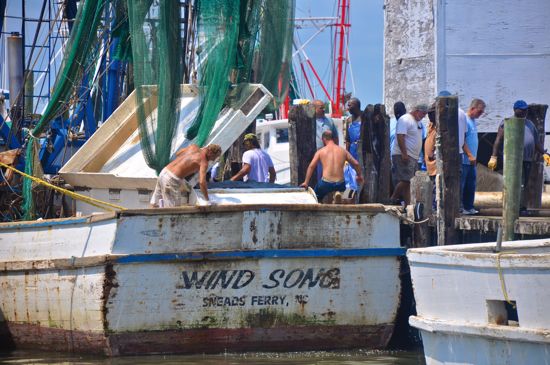 The “Wind Song” out of Sneads Ferry, pulls up alongside the docks at Garland Fulcher Seafood on Friday.
The Garland Fulcher Seafood plant owner says he hadn’t really anticipated this dilemma because he hadn’t expected an abundance of shrimp this year. Sherrill Styron told TownDock that because of the extreme cold this winter, “I would’ve bet anything that there wouldn’t be many shrimp.” Perhaps he says, the warming came just in time. “Then again,” he mused, “I wonder how many we would’ve had” if the winter had been warmer.
On this day in mid-July, that cold winter seems far away and at the Garland Fulcher Seafood Market across Hodges Street from the docks Friday afternoon, 26/30 size (26-30 to the pound) was selling for $7.50 a pound. Larger shrimp was being trucked off and sold wholesale. It’s expected that next week, larger shrimp would be available for retail at the Market.
Posted Friday July 16, 2010 by Melinda Penkava

 • May 2026 - The Pig Celebrates 10 Years • May 2026 - NOAA's Prediction: A Below Average Hurricane Season • April 2026 - Cycle NC 2026 • April 2026 - April Town Board Meeting 2026 • April 2026 - Zac Schnell, AI and Community Engagement • April 2026 - The 2026 Oriental In-Water Boat Show • April 2026 - Eston “Sherrill” Styron, 1942 - 2026 • April 2026 - Capsizing on the Creeks: SailPack 2026 • April 2026 - 2026 PAWS Pet Parade • March 2026 - The Dragon Burn That Didn't • March 2026 - James "Jimmy" Edward Ragan, III, 1941 - 2026 • March 2026 - March Town Board Meeting 2026 • March 2026 - Loblolly Pines & Pollen • March 2026 - Russell "Russ" Bryan Stevenson, 1932 - 2026 • March 2026 - Town Board Acts Fast in Fight for Funds