
It's Monday June 8, 2026

Lots of boats come to Oriental, some tie up at the Town Dock for a night or two, others drop anchor in the harbor for a while. If you've spent any time on the water you know that every boat has a story. The Shipping News on TownDock.net brings you the stories of the boats that have visited recently.
June 1, 2008
Small boat, big trip. Tom and Vickie Matheson set out from their home in Wilmington in mid-May. Their destination – Washington, DC. And after that, Maine. Two people and all their gear.In a 21-foot kayak.
On Sunday, May 18, five days in to the journey, they arrived in Oriental. The pair walked in to the Provision Company asking about a place where they could set up their tent for the night. Jane Wright pointed them in the direction of Grace Evans’ back yard near the kayak launch and the Wildlife Ramp.
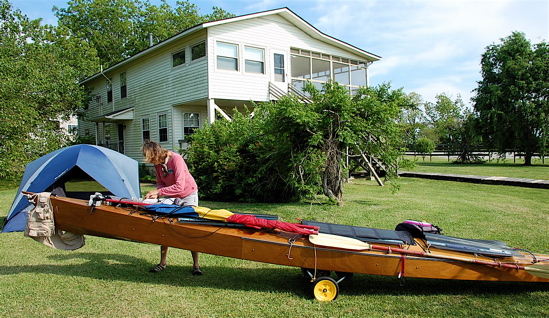 Vickie Matheson, in Grace Evans’ backyard, sets up camp after 8 hours of paddling that day.
Their kayak is outfitted with a sail — a South Pacific canoe design made by Pacific Action of New Zealand. They used it for part of the passage from Adams Creek across the Neuse to Oriental, but then had lots of water action. “Water was washing over everything. We didn’t mind the wet,” Tom says. “We were just happy to be floating. “
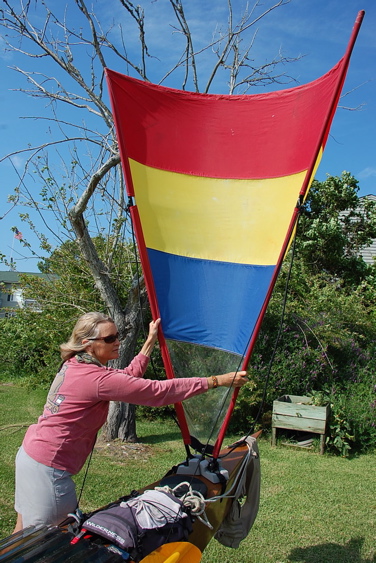 Vickie Matheson shows the sail for their Chesapeake kayak. It is usable in winds abeam and downwind.
They found the wooden kayak on E-Bay about 6 years ago – the previous owner had built it from a kit. “The guy had made it, but he never went out in it,” Vickie says. “He built it, and we get to enjoy it.”
She and Tom have already have taken the boat, which they call, TurtleToo on trips, such as the Everglades and Florida Bay. This year, though, they are taking on something much bigger.
They’re able to take on this longer trip — because Vickie, who has had a hair salon and a day care center and worked in restaurant kitchens, has retired from all that, and Tom retired a few months ago, after 32 years with the National Weather Service, most recently at the hurricane office in Wilmington.
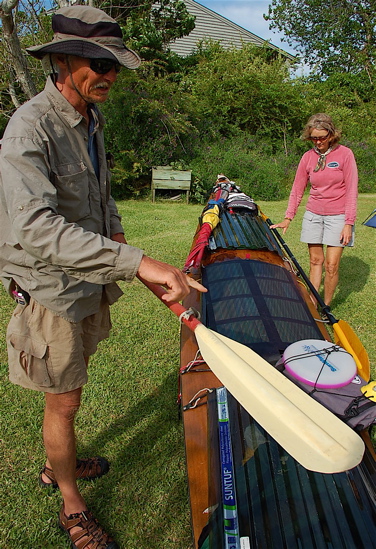 The paddle that Tom Matheson has used for more than 35 years. Vickie’s newer paddle is along the starboard side of their kayak.
It was a kayak trip that set him on that career path in the first place.
Tom says he started out as a white-water kayaker. Around 1973-74, when he was about 20, he set out on a 1500-mile paddle trip of the Great Lakes, with the same paddle he uses now. He paddled on Lake Erie and Lake Ontario and went on to the St. Lawrence. He was on his way to Nova Scotia “to be a lobster fisherman.” But after spending time in Montreal, and unable to speak French, he headed south, and home. Except for getting back to Smithtown, Long Island, he was aimless and by his description, didn’t know what he was going to do.
Then, on the Hudson, a lightning bolt. As kayaked down the river, near Poughkeepsie, a thunderstorm hit. Taking in the drama in the sky Tom says, he said to himself, “‘I think I’ll be a weatherman’.”
To do that, he went in to the military, opting for the Navy because it had “better options for weather stuff”. He spent time on an aircraft carrier — which he had not counted on — and eventually got his degree at Old Dominion. From there, he worked with the National Weather Service in Montana (forest fires were the specialty) and then New Mexico, and the mid-west, training others in Doppler radar. His last 14 years were in Wilmington, where he was the Warning Coordinator Meteorologist.
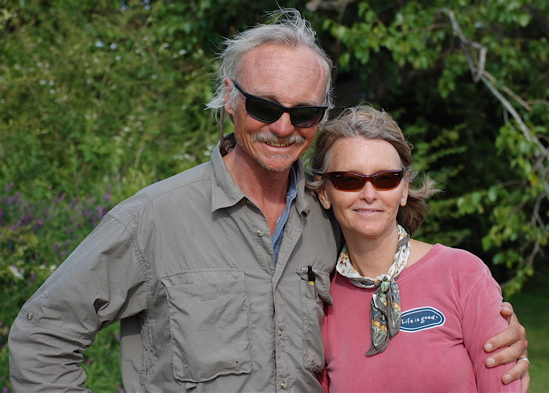 Tom and Vickie Matheson during their stop in Oriental.(And in answer to the question: yes, meteorologists’ homes are not spared the wrath of the hurricanes they forecast. Vickie talked of having a roof fly off their Wilmington home, while Tom was at work, coordinating warnings about a hurricane…. )
And now, with none of those work obligations, they are taking this trip because they want to “do it while we can.”
Their life on the kayak is very simplified.. A 26-watt solar panel charges their few pieces of electronica: a GPS, a VHF weather radio and a laptop computer. The solar panel sits mid-kayak, and soaks up energy, with only the occasional shadow falling on it from a raised paddle.
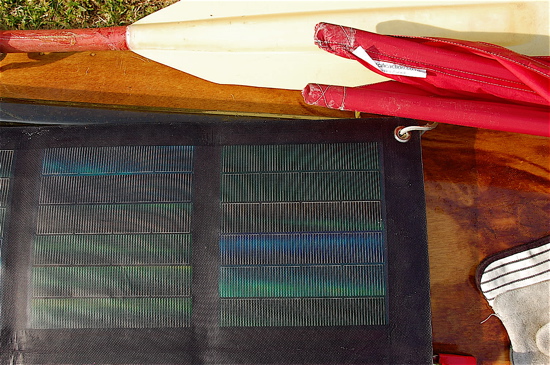 Three forms of power on board the kayak. The paddles. The edge of the sail ribbing. And the solar panel, which, while it does nothing for propulsion, does recharge the batteries.[page]
Tom and Vickie are tapping in to the sun in another way. Before heading out some mornings, Vickie pours dried beans and water in to a glass jar and straps it to the bow. That way, she says, the beans are pre-cooked when they stop paddling and set up camp for the night. At camp, she says, she draws and writes (pen and paper) a journal, while Tom writes updates to a blog of the trip. They carry a few books on board, the library being a forward hold. But they daren’t add more.
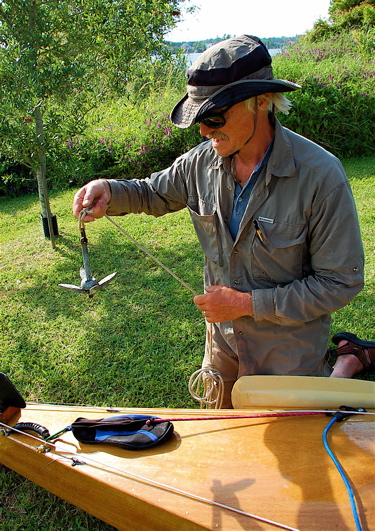 The anchor locker on board the kayak is a water-shoe. They’d found the shoe, two actually and when they didn’t fit anyone they knew, they converted one in to an anchor holder that is easy on the varnish and easy to deploy.
That’s because weight is a consideration. The kayak can handle 700 pounds, but they try to keep the kayak’s total weight — including their trim selves — at 500, for their arms’ sake. “We weigh everything to make sure,” because, as Tom notes, there is the “inertia of that 500-pound slider with a flat V- bottom and hard chine.”
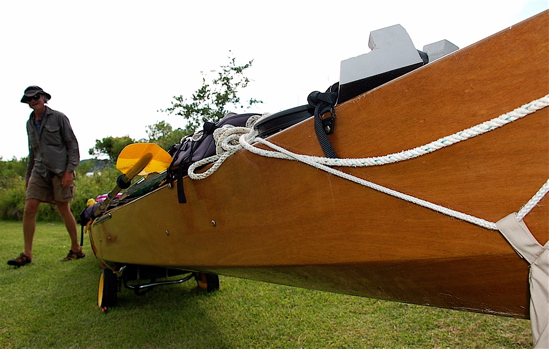 The underside of the wooden sea kayak.
If there’s a wind out of the north, they say, they won’t venture out because they don’t want to “tear our arms apart.” Stopping early and setting up camp just because they’re tired isn’t always an option when you’re kayaking past the marshy banks of the ICW in NC. For the anticipated pain from 8 hour days of paddling, they take ibuprofin in the mornings and evenings.
Some days, the ibuprofin can’t keep up. A few days after leaving Oriental, they encountered a particularly tough patch in the waters of northeastern NC. An email from Tom described them as feeling “trashed… pulling/pushing and sliding along at 1-2.5 mph…shoulders in shocking pain…”
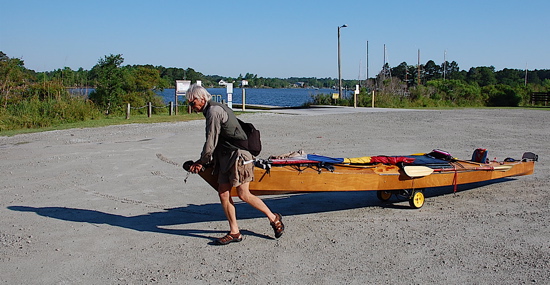 Some of the work comes before the boat goes in the water. Tom Matheson pulls the kayak across the parking lot at the end of Midyette Street. The two wheeled “trailer” is how they maneuver the boat on land.
The trip isn’t all paddling, of course. They say they use the sail about half of the time. When the Mathesons left Oriental, they paddled a half dozen strokes out from the kayak dock, and then raised the sail.
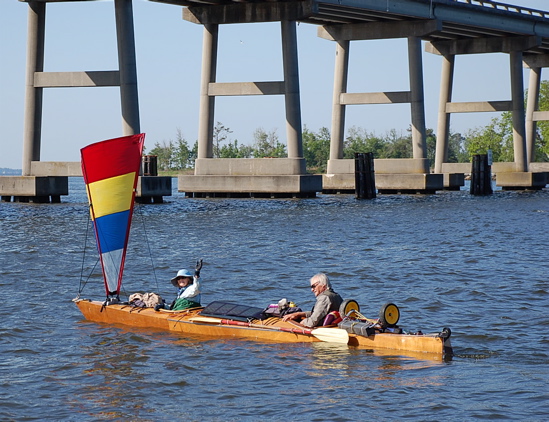 Letting the wind do the work. Tom and Vickie Matheson depart Oriental on May 19. Note the solar panel at the center of the boat, and the stowed “trailer” at the aft.
Their plan is to paddle everyday unless it’s raining or windy. Vickie laughed about having a “lobster and a cold beer waiting for me,” at Tom’s sister’s place on Swans Island near Bar Harbor, Maine. But they also talked about being flexible. Travel in a kayak has unforeseen obstacles. “We are in no big hurry.”
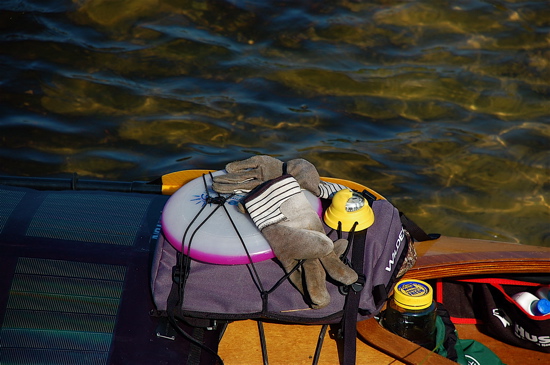 Tom’s “Navigation Station”. Compass bearing: north.
And along the way, there’s a chance to talk. Out there on the water, paddling a few feet from each other, Tom says they sometimes have 12 different conversations going. “We talk about the exercise/wind/wave issues at hand… then we’re able to pick up where we left off.”
They are getting better acquainted, and “testing limits.”
This trip, he says, “is more intense, rewarding and dangerous than the other endeavors, and the scenery’s pretty good and gives us this opportunity to chat.”
—-
As this story was about to publish we learned that Tom and Vickie had decided at Norfolk that this trip was over. Tom writes:
This leg of the voyage is over – we rented a car in Norfolk, loaded the kayak and drove up to DC to visit the folks and regroup. V had had enough – she gave it her all till it was all gone, and when she said it was time to do something else, well…that’s what we’re doing. She said she felt like she aged 10 years in 2 weeks, and so had I…she said. I don’t see it that way, but it takes 2. We’re disappointed, but…hey – what the heck. I’ll have an opportunity to get my bones back in their sockets and we’re planning on heading back to fresh water and do some of the rivers running across this continent – kayaking in salt water is a stretch of patience and endurance and tolerance of inhospitable conditions like salt and staying too far off the coast to catch wind and there are too few good places to stop and stand or camp – we’d get in the boat at 9 am and get out at 6 or 7 pm… it seemed we were working to get somewhere and enduring where we were, ever struggling to move on. Rivers will carry us and life will be easier.Tom, Vickie and kayak “Turtletoo.” Voyagers from Wilmington to Norfolk.While they say they are not continuing North on the ICW, they are also not planning to return home to NC, but will instead continue traveling – amphibiously – with the kayak.
Link:
Posted Sunday June 1, 2008 by Melinda Penkava


 • May 2026 - From Argentina to Whortonsville • February 2026 - Mads and SV Spiffy • July 2025 - John and the Birds • July 2025 - Capt. Carl Cannon Jr. & Pirate Ship “Adventure” • June 2025 - SV Mysto • March 2025 - 1926 Motor Yacht Mariner III • January 2025 - SV Skookum Takes On The World • November 2024 - SV Naia • March 2024 - Wes Barbour and SV Summer Wind • December 2023 - Pauline and SV Elektra • October 2023 - The Coati & The Mermaid • June 2023 - SV White Seal • April 2023 - SV Sarah G • March 2023 - SV Pepita • February 2023 - S/V Surprise • January 2023 - SV Thunderstriker • December 2022 - S/V Capitaine Bontems • November 2022 - Schooner Huron Jewel • July 2022 - Ashley, Apache, and SV Friends • February 2022 - Sam Rouse and SV Nortena • December 2021 - Coastal Conversations • February 2021 - Brother Sister Dory Story • December 2020 - Alan, David Bowie, and Blue 9 • November 2020 - Waiting for the Right Time • September 2020 - Camping in the Creeks • August 2020 - Solo Cruiser Emily Greenberg • June 2020 - SV Mudfog Cove Returns • March 2020 - SV Beyond • February 2020 - Shahid & SV Safina • January 2020 - Electric Vessel with Historic Roots • May 2019 - SV Misto Circumnavigates • April 2019 - MV Sea Glass • March 2019 - Steve Chard: Kayaking the Great Loop