
It's Tuesday May 12, 2026

Lots of boats come to Oriental, some tie up at the Town Dock for a night or two, others drop anchor in the harbor for a while. If you've spent any time on the water you know that every boat has a story. The Shipping News on TownDock.net brings you the stories of the boats that have visited recently.
NEPENTHE -- Going South, Going Aground
October 19, 2002
"We've gone aground four times."
In Oriental recently, Dennis Robinett delivered this line as though it were something significant.
Of course, going aground anywhere can bruise a sailor's ego. And on this, their first trip south from Connecticut on the ICW, Dennis and his wife Suzi were learning that bay and sound waters don't always run deep.
They were also finding -- happily -- that going aground in the muddy bottom of Pamlico Sound wouldn't harm their Cape Dory 36, "Nepenthe" like a grounding in the rocky waters off Connecticut and New England would. There, running hard aground can mean very hard times.
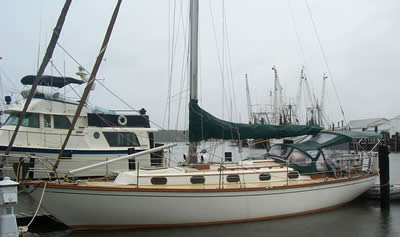
Not far from their marina in Groton, CT, outcroppings of shale and other rock lurk just below the surface. There's one pile, says Dennis, "that actually has a sign that says "Rocks" on it". And still, sailors go up on them. Getting in to shallow waters in the Northeast "can get expensive". Suzi seconds that. At Shennecossett Y.C she says "There were 6 or 8 boats this summer alone, that needed yard work after going aground."
It's just a fact of life.... and in some cases, after life.
Suzi recalls one friend in Connecticut who scattered her husband's ashes near submerged rocks where he had gone aground a number of times. "'He liked it so much', she told us, 'that now he can get to see it" up close.
Given that background, it's not hard to understand why Dennis says, "We weren't comfortable going aground before this trip."
Softer groundings aren't the only thing the Robinettes have noticed as they head south toward Florida.
There was the bullet-riddled silhouette of a man that had been propped near a NO WAKE sign in the Dismal Swamp. "I saw that and said, 'I think we really ought to slow down here'" says Suzi. She had some concerns that the target practice might resume across the canal she was traveling down.
Waves in the South
Dennis Robinett meanwhile, notices that the further south they go, the more other boaters wave.
"I grew up in the midwest," he says, "in a small town like this in Illinois" where it was common to wave to neighbors, on land or water. When he moved to the northeast more than three decades ago, he found few people returning his wave. "It was like, "Who IS he?' In NY and NJ, they just stared at me." But Dennis says that as they've headed south on the water, he's found more of the waving he remembers from his childhood.
The Robinettes stopped in Oriental for the Columbus Day weekend and their son, daughter-in-law and grandson who live in Raleigh met up with them on "Nepenthe".
Now the Robinetts are heading toward Stuart, FL where they are resettling after moving from Connecticut. As for cruising plans, they think they'll be heading north for the summers. They have no plans for much offshore cruising. At least together. Suzi says she's more comfortable with the way a 747 goes to windward.
Their boat's name is pronounced "nih-PEN-thee", which Suzi says may sound like they're lisping when giving the name over VHF. The name comes from that of a famous racing boat. But way before that, "Nepenthe" appeared in "The Odyssey" as an "elixir that soothed the soul when times are rough".
One hesitates to bring it up, but Homer's Odyssey also had a whole section about sailors stuck between a rock and a hard place.... but then again, the further south the crew of Nepenthe travels, the less they worry about either.
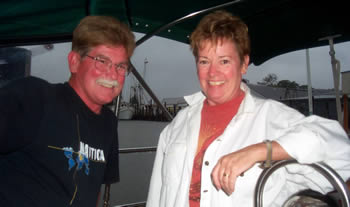
Posted Saturday October 19, 2002 by Melinda Penkava


 • May 2026 - From Argentina to Whortonsville • February 2026 - Mads and SV Spiffy • July 2025 - John and the Birds • July 2025 - Capt. Carl Cannon Jr. & Pirate Ship “Adventure” • June 2025 - SV Mysto • March 2025 - 1926 Motor Yacht Mariner III • January 2025 - SV Skookum Takes On The World • November 2024 - SV Naia • March 2024 - Wes Barbour and SV Summer Wind • December 2023 - Pauline and SV Elektra • October 2023 - The Coati & The Mermaid • June 2023 - SV White Seal • April 2023 - SV Sarah G • March 2023 - SV Pepita • February 2023 - S/V Surprise • January 2023 - SV Thunderstriker • December 2022 - S/V Capitaine Bontems • November 2022 - Schooner Huron Jewel • July 2022 - Ashley, Apache, and SV Friends • February 2022 - Sam Rouse and SV Nortena • December 2021 - Coastal Conversations • February 2021 - Brother Sister Dory Story • December 2020 - Alan, David Bowie, and Blue 9 • November 2020 - Waiting for the Right Time • September 2020 - Camping in the Creeks • August 2020 - Solo Cruiser Emily Greenberg • June 2020 - SV Mudfog Cove Returns • March 2020 - SV Beyond • February 2020 - Shahid & SV Safina • January 2020 - Electric Vessel with Historic Roots • May 2019 - SV Misto Circumnavigates • April 2019 - MV Sea Glass • March 2019 - Steve Chard: Kayaking the Great Loop