
It's Monday June 15, 2026

Lots of boats come to Oriental, some tie up at the Town Dock for a night or two, others drop anchor in the harbor for a while. If you've spent any time on the water you know that every boat has a story. The Shipping News on TownDock.net brings you the stories of the boats that have visited recently.
April 24, 2007
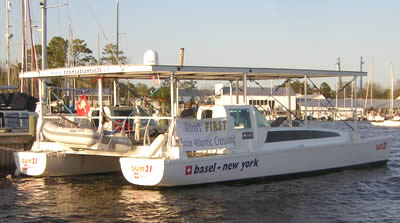
On Earth Day, a rather fitting boat arrived in Oriental. This winter, the catamaran “Sun21” became the first boat to cross the Atlantic strictly by way of solar electric power. The 42-foot long cat from Basel, Switzerland has no sail, and no diesel or gas engine. Instead, a canopy of solar panels stretches above and between the two hulls. The sun’s rays power the boat’s electric motor.
Three of the crew, skipper Michel Thonney, Martin Vosseler and Beat von Scarpatetti had set out from Switzerland last October. Then a few months later, they and Sun21 made the first-of-its-kind passage from the Canaries to Martinique. That crossing took 29 days. They averaged about 5 knots. From Martinique, Sun21 and its crew worked their way toward Miami and up the East Coast. They are now on their way to New York City which they hope to reach by May 8th.
Oriental was an unplanned stop along the way, yet the arrival on Earth Day underscored the purpose of Sun21’s 7,000-mile trek from Basel to NY. Sun21’s crew is out to show that the man-made climate change can be prevented, that there are ways, other than diesel and gas to power an engine. As Martin Vosseler put it, “the boat can be a symbol of a new start… of good sustainable technology.”
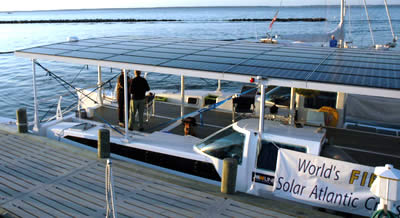
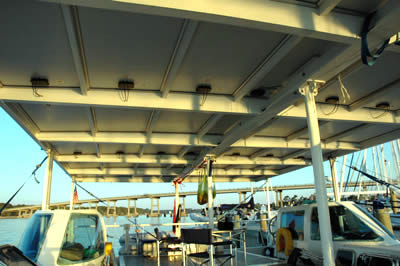
The view from above – an entire “bimini” of solar panels – generating up to 10kw in full sun.The boat takes its name from Sun21, a Swiss-based international forum that promotes renewable power sources and energy efficiency. It’s been around for about 10 years. Martin is part of Sun21. He says he was a medical doctor until a dozen years ago when he got in to what he called the ‘preventive medicine’ of “preserving living conditions on the planet”. He says the idea of crossing the ocean on a solar-powered boat came up a few years ago.
Initially, he says, someone suggested they solar-power a freighter. But the prospect of the sun replacing the energy of tons and tons of diesel was daunting. Instead, they decided to use a catamaran, and chose one that had been part of a quartet used on lakes in Switzerland.
The boat is 14 metres long and 6.6 metres wide, or about 42 feet by 20. It draws 3 feet. Martin, who hasn’t sailed before, but who has crossed the Atlantic in a cargo ship, says the trip over was pretty smooth. They encountered rough seas three times in 29 days. Through it all, the solar power kept the boat moving forward.
So, what happens when there are dark skies, with no sunlight? Martin says that the boat’s batteries — in the forward parts of the hulls — can store enough energy to last 20 hours. Though there was some cloudy weather, he says they kept powering though it. The boat can reach a maximum speed of 9 knots, but they averaged 4-6.
Aside from the savings on diesel and gas, the solar powered electric motor had another advantage. The quiet. Martin says there was “practically no noise, no vibration” as the boat glided along.
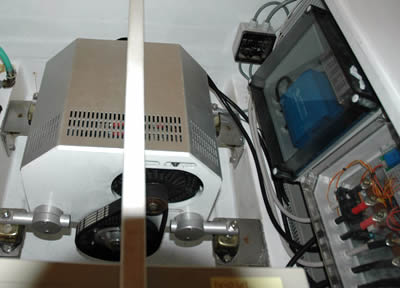
One of the two 48 volt DC motorsHe says he was taken by how ‘really well it works.” And surprised “that there are not more of these boats around.”
One initial impediment might be price. The catamaran is priced at about $800,000 and the power system itself he says, cost about $80,000.
But on smaller boats, Martin sees the possibility of hybrid systems….. sails coupled with solar-powered electric. (Some might suggest a hybrid could also involve a diesel, while people wean themselves from the conventional engine, but he prefers the renewable energy sources in the hybrid.)
With the ocean passage behind them, the journey continues in another sense: spreading the word about the solar powered boat. The crew is bound for New York — a meeting at the UN, and with the Explorer’s Club there. And visiting other towns along the way.
Martin says that they’ve enjoyed the ‘beauty of the Southern states.” In Oriental he mentions the “live oaks” in particular. He says the crew has gotten a warm reception in its travels. Even out on the water, he says, passing boats seeing the solar panels and the sign about the Atlantic crossing, have been giving them the thumbs up. Martin suggests that “the consciousness has changed in the last five years.”
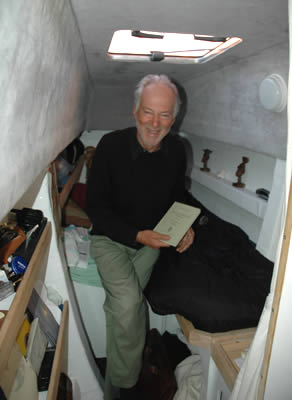
But his long-time friend and fellow in Sun21, Beat von Scarpatetti questions how aware people may be. Nine years ago, Beat wrote a book-length Ecological Constitution of Switzerland, (a copy of which he pulls out of a nav station on Sun21.) Beat says he tries to be careful not to preach and takes pains to say that he’s found Americans to be “very open, gentle, smiling.” But he has also noticed that while people in the US may grasp the “theoretical” about solar power, renewable sources and energy efficiency, they don’t put it in to practice with their ‘daily behavior’.
Down below, Beat von Scarpatetti and his bookHe notices that in the US, cars are “too big. “. He remarks on seeing engines kept running outside of supermarkets. There is he says, “horrible wasting” of energy. He mentions a visit to a school in Jacksonville, Florida. It had been a beautiful spring day, Beat says, yet inside the building “it was freezing. We had to go fetch our pullovers,” because the air conditioning had been switched on.
(When the TownDock.net crew arrived just before sunrise on Monday to interview the crew, one of the first things Beat said as he greeted us was that the bicycles we’d parked against a piling on Oriental Harbor Marina’s A Dock were among the few bikes he’d seen in America.)
On board “Sun21” the solar arrays provide welcome shade from the sun. (A Bimini-With-A-Purpose)Down below on “Sun21” the quarters are tight. In the head, two violins are stored. They belong to Beat and Martin. They played them a few nights before in McClellanville, SC when they ran in to some local musicians. Beat and Martin’s taste in fiddle music runs to classical. “Monteverdi and Debussy,” Beat says, noting that while coming through Wilmington two days earlier, they’d heard Debussy’s “La Mer” playing on a radio station there.
On Monday, the trio from Switzerland headed not exactly in to the ‘mer’ but in to the Pamlico Sound, on their way toward NY and the May 8th appointment at the UN. Joining them for this final leg of the trip was John Wenz, an American marine surveyor who works with the Riverkeeper organization on the Hudson river.
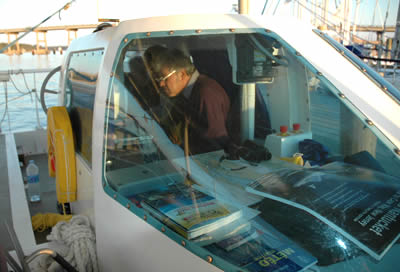
Three crew members crowd into the port “pilot housde” to plan the day’s journey north.
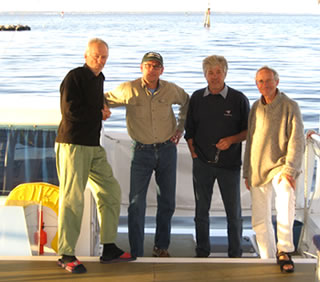
The “Sun21” crew – Beat von Scarpatettit, John Wenz, Michel Thonney and Martin Vosseler.The fifth crew member, of course, the one pulling all the weight, was a bright sun they glided towards in the early morning light.
Posted Tuesday April 24, 2007 by Melinda Penkava


 • May 2026 - From Argentina to Whortonsville • February 2026 - Mads and SV Spiffy • July 2025 - John and the Birds • July 2025 - Capt. Carl Cannon Jr. & Pirate Ship “Adventure” • June 2025 - SV Mysto • March 2025 - 1926 Motor Yacht Mariner III • January 2025 - SV Skookum Takes On The World • November 2024 - SV Naia • March 2024 - Wes Barbour and SV Summer Wind • December 2023 - Pauline and SV Elektra • October 2023 - The Coati & The Mermaid • June 2023 - SV White Seal • April 2023 - SV Sarah G • March 2023 - SV Pepita • February 2023 - S/V Surprise • January 2023 - SV Thunderstriker • December 2022 - S/V Capitaine Bontems • November 2022 - Schooner Huron Jewel • July 2022 - Ashley, Apache, and SV Friends • February 2022 - Sam Rouse and SV Nortena • December 2021 - Coastal Conversations • February 2021 - Brother Sister Dory Story • December 2020 - Alan, David Bowie, and Blue 9 • November 2020 - Waiting for the Right Time • September 2020 - Camping in the Creeks • August 2020 - Solo Cruiser Emily Greenberg • June 2020 - SV Mudfog Cove Returns • March 2020 - SV Beyond • February 2020 - Shahid & SV Safina • January 2020 - Electric Vessel with Historic Roots • May 2019 - SV Misto Circumnavigates • April 2019 - MV Sea Glass • March 2019 - Steve Chard: Kayaking the Great Loop