
It's Friday July 31, 2026
News From The Village Updated Almost Daily

Lots of boats come to Oriental, some tie up at the Town Dock for a night or two, others drop anchor in the harbor for a while. If you've spent any time on the water you know that every boat has a story. The Shipping News on TownDock.net brings you the stories of the boats that have visited recently.
August 10, 2011
1 2 3 next page ›
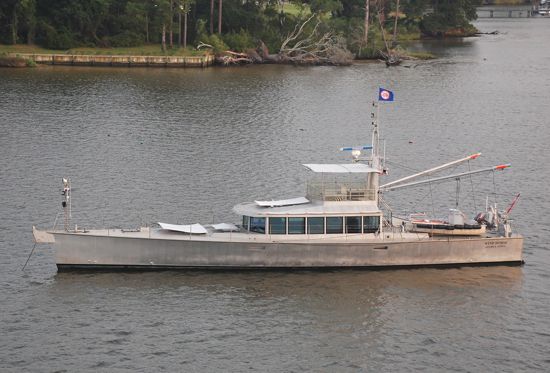
One recent evening, just before sundown, a battleship-gray vessel steamed past the Oriental anchorage, motored under the bridge and dropped anchor at the mouth of Greens Creek. The vessel’s plumb destroyer bow and ash colored hull seemed out of place in North Carolina’s sailing capital. The vessel looked too purposeful to be merely a pleasure boat – too angular, too metallic. It had onlookers wondering. Was this a navy vessel, perhaps from a far off country?No. It was Steve and Linda Dashew aboard their 83-foot vessel “Wind Horse”.
Wind Horse anchored in Greens Creek. To the casual observer, Wind Horse looks military. “We are often mistaken for the Navy,” Linda says.Steve and Linda DashewTo understand Wind Horse and her unconventional looks, one has to look back into Steve and Linda’s sailing past – about half a century’s worth.
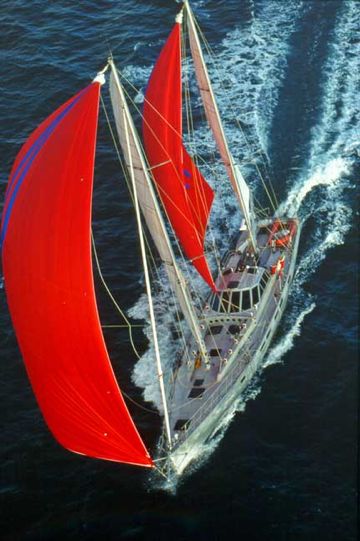
In the 1960s, Steve set the world speed sailing record aboard his D-Class catamaran “Beowulf”. Later, the couple sailed around the world in the “Intermezzo II”, their Columbia 50. Over the years, though, they never quite found the boat that met their cruising needs. So they designed and built the Deerfoot and Sundeer line of sailboats. Long and narrow, the premise behind these 60 and 70 foot boats was that a couple could sail them offshore in comfort and safety without additional crew.
“Beowulf”, the Dashew’s previous 78-foot sailboat. On passage, Steve and Linda were often the boat’s sole crew. (Steve and Linda Dashew photo)Not only did they design and build these boats, they sailed them. Lots. Over the years, the couple racked up tens of thousands of offshore miles. Fast passage makers, these vessels are known to sail up to 300 miles per day while most sailors settled for half that. Steve says this allowed the boats and their crews to minimize time, and therefore poor weather, offshore. Steve and Linda chronicled these experiences in books such as “Surviving the Storm”, “Offshore Cruising Encyclopedia” and “Mariner’s Weather Handbook”.
In time, though, Steve discovered a change that might not be as easily skirted or outrun. It wasn’t a meteorological storm. It was, Steve says, the march of time. Hauling and lowering sails on passage, day and night, in weather good and poor, was not as easy as it once was. So he and Linda decided on a life course correction. Not content to stow the anchor, they did what many diehard sailors would consider treason. They took up powerboating.
1 2 3 next page ›

Posted Wednesday August 10, 2011 by Bernie Harberts


 • July 2026 - Marcel Lafond and SV Prospector • May 2026 - From Argentina to Whortonsville • February 2026 - Mads and SV Spiffy • July 2025 - John and the Birds • July 2025 - Capt. Carl Cannon Jr. & Pirate Ship “Adventure” • June 2025 - SV Mysto • March 2025 - 1926 Motor Yacht Mariner III • January 2025 - SV Skookum Takes On The World • November 2024 - SV Naia • March 2024 - Wes Barbour and SV Summer Wind • December 2023 - Pauline and SV Elektra • October 2023 - The Coati & The Mermaid • June 2023 - SV White Seal • April 2023 - SV Sarah G • March 2023 - SV Pepita • February 2023 - S/V Surprise • January 2023 - SV Thunderstriker • December 2022 - S/V Capitaine Bontems • November 2022 - Schooner Huron Jewel • July 2022 - Ashley, Apache, and SV Friends • February 2022 - Sam Rouse and SV Nortena • December 2021 - Coastal Conversations • February 2021 - Brother Sister Dory Story • December 2020 - Alan, David Bowie, and Blue 9 • November 2020 - Waiting for the Right Time • September 2020 - Camping in the Creeks • August 2020 - Solo Cruiser Emily Greenberg • June 2020 - SV Mudfog Cove Returns • March 2020 - SV Beyond • February 2020 - Shahid & SV Safina • January 2020 - Electric Vessel with Historic Roots • May 2019 - SV Misto Circumnavigates • April 2019 - MV Sea Glass