
It's Saturday June 13, 2026
May 29, 2013
For the third time in six months, Oriental’s harbor has been fouled. The odor of fuel could be smelled ashore late Monday night and continued through Tuesday morning. At midday Tuesday, the water off of the Town Dock and for several dozen yards away, wore a rainbow sheen.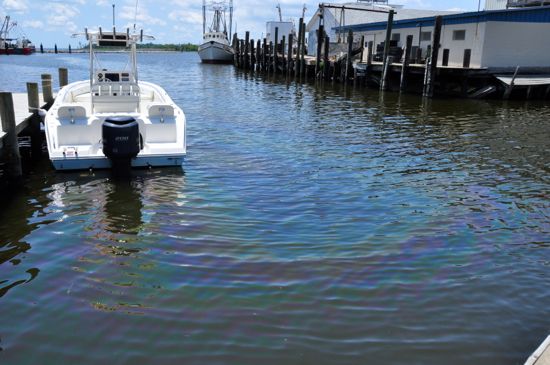 Oriental harbor Tuesday afternoon with what the Coast Guard identified only as “an unrecoverable sheen.” By the time the Coast Guard arrived, its crews said it couldn’t determine where the spill came from.
A resident alerted the National Response Center, which sent the Coast Guard from Fort Macon to pay a visit around midday. The Coast Guard office in Wilmington describes what the crew found as an “unknown” and “unrecoverable sheen” but went no further to say what it was.
By the time the Coast Guard arrived, the investigators could find “no point of discharge.” As such, says Petty Officer Rooke in Wilmington, the Coast Guard “could not pinpoint who was responsible.”
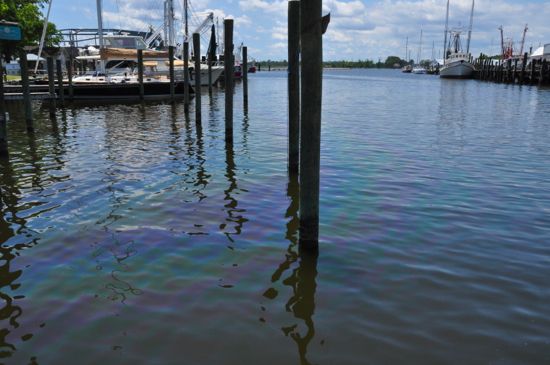 The “unrecoverable sheen” which the Coast Guard didn’t identify.
Rooke and Paymaster Johnson at the Wilmington Coast Guard office said that the Pollution Response Team who investigated reported that they couldn’t link the spill to any one boat because “there were no boats in the area” of the spill. They said a dockmaster told investigators that the sheen could have been left by a transient boat.
No action was taken to contain the pollution. It was “left to dissipate,” said Rooke.
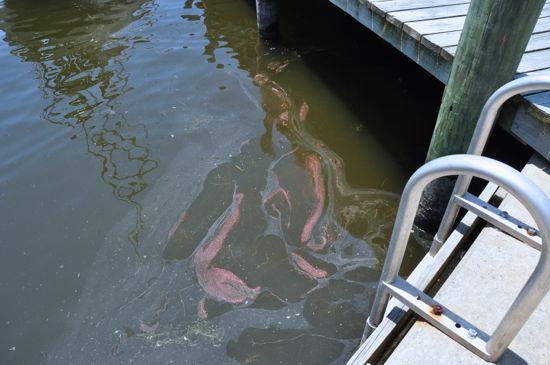 In addition to the sheen on the water surface, some pink and red particulates collected near the Town Dock. The Coast Guard says the source of the pollutant is unknown.
If someone had called the Coast Guard when the spill first was detected, Monday night, Rooke says the chances were greater that the Coast Guard “could’ve seen the boat” that was discharging in to the waters of Oriental’s harbor.
He urged the public to call as soon as they see something amiss, a point made by several other officials Tuesday. They say that the more people who call, the more likely the spill will be addressed.
This is the third spill on Oriental’s harbor that residents have called about in the past half year. In December, three days of sandblasting a trawler at Chris Fulcher’s Point Pride Seafood put dust on the harbor water. The odor of solvents hung in the air over the harbor and could be smelled several blocks away. In January, the wooden trawler Lady Barbara sank at the Garland Fulcher docks and spewed a pink goo of fuel, lubricants and oil on to the harbor and spread past the Oriental Bridge.
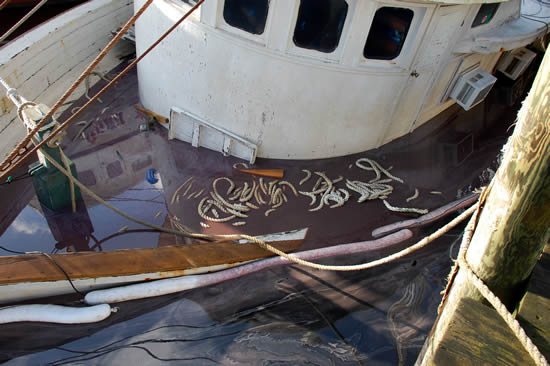
The Lady Barbara sank in January at the docks of Garland Fulcher seafood on the west side of Oriental’s harbor. The booms around the hull couldn’t contain all of the pollutants. They spread across the harbor as well as up nearby creeks.Who To CallBased on those recent experiences, here is a list of what agencies to call, and in what order.
National Response Center – 1-800-424-8802
NC Division of Water Quality – Washington, NC regional office of NC Department of Environment and Natural Resources – 252-946-6481. After hours – evenings and weekends – call the Raleigh office – 1-800-858-0368.
NC Division of Air Quality – Washington, NC regional office of NC Department of Environment and Natural Resources 252-946-6481. After hours – evenings and weekends – call the Raleigh office – 1-800-858-0368.
Oriental Police Captain Dwaine Moore – 252-675-1859 (cell) 252-249-0369 (via dispatcher)
Neuse River Foundation, Creekkeeper, Oriental, Bill Hines – 252-571-0264
Neuse River Foundation, Lower Neuse Riverkeeper, Mitch Blake – 252-495-1803 (cell) 252-637-7972 (office/answering machine)
Just ahead: More details on calling about pollution and lessons learned from earlier spills.
[page]
More Details on Who To CallFor all spills, call the National Response Center at 1-800-424-8802. It is connected with the Coast Guard. Explain what you see or smell. You will be given a case number. The way the system is supposed to work, the NRC is supposed to contact the agency that would have jurisdiction over the spill.
If it’s a fuel or oil spill, the NRC should contact the local Coast Guard to respond. If you call the Coast Guard directly at their North Carolina 24 Hour Operations Center (910-362-4015) you will likely be told to call the NRC first.
Don’t limit yourself to calling one agency and don’t wait for the NRC to call agencies other than the Coast Guard.
If the spill is not fuel or oil — if it’s particulates or paint or solvents or a fish kill in the water — the agency to call is the NC Division of Water Quality. DWQ is a part of the NC Department of Environment and Natural Resources and the public should call the regional office in Washington, NC, at 252-946-6481. If it’s after business hours (after 5p) or on a weekend, call the office in Raleigh at 1-800-858-0368.
Note: DWQ no longer has its Neuse River Rapid Response team to come out and investigate right away. (It was cut from the budget 2 years ago.) Experience has shown that it could be days before DWQ arrives. As a result prosecution and fines may be hard to get in these cases. Still, if you have photos of the pollution and know where it’s coming from, that can be helpful information to email to DWQ and may prompt them to take action to at least make the pollution stop.
Meanwhile, if you also smell something that doesn’t seem right – something that should be contained within a paint shed, for instance – contact the NC Division of Air Quality, also out of the DENR office in Little Washington, at 252-946-6481.
Since the spill or pollution could be a law enforcement issue, contact Oriental’s Police Captain Dwaine Moore at 675-1859(mobile) or 249-0369 (the dispatcher)
Contact the Neuse River Foundation. The local Creek Keeper is Bill Hines who lives in Oriental. Letting him know about a problem is a good idea as well. Bill can be reached at 252-571-0264.
The Lower Neuse Riverkeeper is Mitchell Blake. His cell number is 252-495-1803 The office number, where you may get an answering machine, is 252-637-7972. (Better to call the cell.)
Lessons Learned From Two Earlier Incidents: Little ProsecutionThe Lady Barbara’s January sinking and polluting wasn’t limited to Oriental’s harbor. The oily fuel mix spread to Smith and Greens Creeks. Upper Greens’ creek is a nursery area for shrimp. Yet, as TownDock reported at the time — the maximum fine the Coast Guard could levy in this case was $3,000. It is not clear if the Coast Guard is seeking even that.
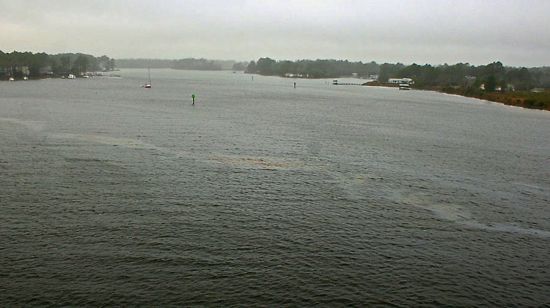 The fuel spill from the Lady Barbara extended out of the harbor, under the Oriental bridge and as can be seen here, up Greens Creek. This photo was taken two days after the spill, on Thursday January 17. The creek’s upper reaches are a sensitive nursery for shrimp and other aquatic life.
The Coast Guard handles only fuel and oil spills. That became apparent in an earlier incident, in December of last year, when some residents called the National Response Center to complain about a film of dust on the harbor. It had been billowing out from Chaz’a Toy, a trawler kept at the docks of Chris Fulcher’s Point Pride Seafood.
Crews there had been sandblasting the paint off the trawler. They did so out in the open, without using an enclosure as law requires. The NRC called on the Coast Guard to investigate, which it did and then said that since fuel was not spilled, it had no jurisdiction.
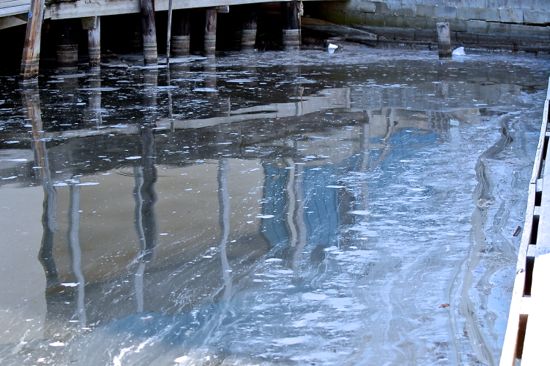 Scene from the December incident on Oriental’s harbor. Because of the sandblasting at the other end of the harbor at Point Pride seafood, a film of dust formed at the far north end of the harbor, against the concrete wharf wall.
A full day was lost before residents figured out to call the NC Division of Water Quality office in Washington, NC. Upon receiving photos and video of the pollution from the sand blasting and complaints of strong solvent smells that could be smelled in the air blocks away, DWQ forced Fulcher’s crew to cease and desist until they erected a tent around their work.
In previous years, the Neuse River Rapid Response team might have arrived inside of an hour from their office in New Bern. But the Legislature cut funding for that team. It no longer exists. And so, it took DWQ three days to send a representative to Oriental to investigate. By then, the evidence had dissipated from the harbor and there was no longer the strong smell of solvents in the air.
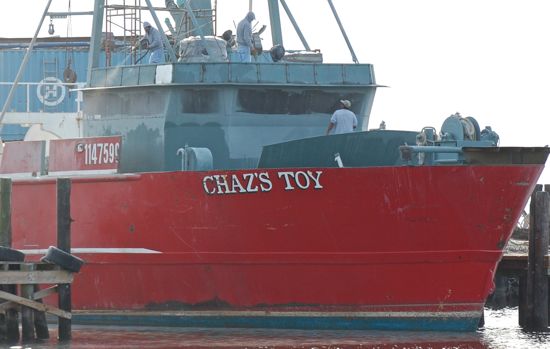 A worker blasts the surface of the trawler Chaz’s Toy in December at the docks of Point Pride Seafood without benefit of tarps to contain the dust. (It was not the first such incident there. Several years earlier during an un-enclosed paint job on a trawler, yard long ribbons of red paint floated across the harbor and beyond.)
DWQ’s Surface Water Protection Supervisor, Amy Adams said in December that DWQ was laying the groundwork to fine Chris Fulcher as much as $10,000 a day for polluting the harbor in that December incident. (She said at the time that there had been a history of violations there.) DWQ sent Fulcher a Notice of Violation in early January.
Then, by early March, DWQ dropped the case. The reason: Fulcher claimed that no solvents were released.(Click here to read Chris Fulcher’s letter to DWQ.)
Proving Pollution Occurred: The Water Sample ChallengeIn March, Amy Adams told TownDock.net that since there was no water sample taken on the harbor, an attorney with the state said the case could not hold up in court. It didn’t matter that residents — one of them a chemical analyst with 40 years experience — said that they smelled the solvent odor blocks away. There could be no prosecution because there was no proof that solvents had gotten in to the water nor that they came from the sand blasting operation.
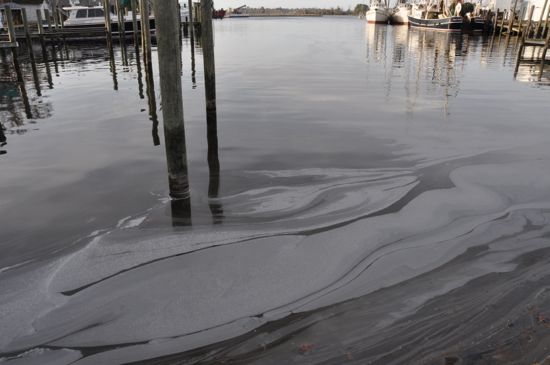 The gray particulates that accumulated on the surface of the harbor in December while a crew worked on Chaz’s Toy at Chris Fulcher’s Point Pride Seafood at the other end of the harbor. DWQ told Fulcher that the work had to be done in an enclosure, which was subsequently done. There were to be no monetary penalties for violating water quality standards, as no water samples were taken at the time.
Not just any water sample would do, either. Amy Adams said that to stand up in court, the samples have to be collected by someone who can guarantee a “chain of custody” – basically, to ensure that there was no tampering with the water samples before they got to a lab. Oriental Police Captain Dwaine Moore told TownDock.net earlier this spring that he would be willing to be trained in gathering such samples.
While these earlier cases did not lead to a prosecution – and the most recent spill will not either – another Division of Water Quality staffer urges the public to pick up the phone and call when they see pollution. “Don’t stop complaining,” DWQ’s Environmental Senior Specialist Jill Paxson said on Tuesday.
Bill Hines, the volunteer Creekeeper for Oriental with the Neuse River Foundation sees a value in that as well, “Anytime folks report problems instead of shaking their heads and moving on, it helps to spotlight the problem.” The sooner a report is made the better the chances, says Hines, of finding the source and working with them to prevent a repeat.
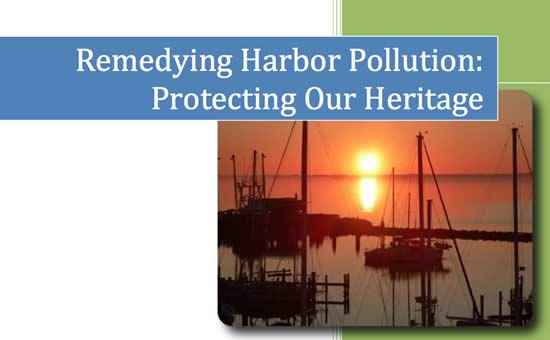
Report: Remedying Harbor PollutionMatt Triplett and Graham Cronogue, two Duke law students, suggest that better enforcement and fines are needed to deter such polluters as well. They write about that in their report — “Remedying Harbor Pollution” — which came out a few weeks ago. Their paper on what the public can do, stems from Oriental’s experience this winter when the Lady Barbara sank in Oriental’s harbor and its pollutants – a soup of oil, fuel and lubricants – spread beyond the harbor and up Greens and Camp Creeks. As mentioned, the Coast Guard’s top fine for such an incident is $3,000.
Triplett and Cronogue’s paper says that “In port cities and sailing towns like Oriental, chemical discharge and water pollution are almost certain to reoccur. However, the type of inaction and blame shifting that followed the Lady Barbara spill is not inevitable. It is the authors’ hope that this white paper will minimize response times and facilitate action (both proactive and reactive) within communities affected by similar environmental pollution.”To read “Remedying Harbor Pollution” click here. Supervising on the project were Oriental resident and Duke University School of Law professor emeritus Michael Tigar, and Ryke Longest, who heads the Environmental Law and Policy Clinic at the law school.
Posted Wednesday May 29, 2013 by Melinda Penkava

 • May 2026 - The Pig Celebrates 10 Years • May 2026 - NOAA's Prediction: A Below Average Hurricane Season • April 2026 - Cycle NC 2026 • April 2026 - April Town Board Meeting 2026 • April 2026 - Zac Schnell, AI and Community Engagement • April 2026 - The 2026 Oriental In-Water Boat Show • April 2026 - Eston “Sherrill” Styron, 1942 - 2026 • April 2026 - Capsizing on the Creeks: SailPack 2026 • April 2026 - 2026 PAWS Pet Parade • March 2026 - The Dragon Burn That Didn't • March 2026 - James "Jimmy" Edward Ragan, III, 1941 - 2026 • March 2026 - March Town Board Meeting 2026 • March 2026 - Loblolly Pines & Pollen • March 2026 - Russell "Russ" Bryan Stevenson, 1932 - 2026 • March 2026 - Town Board Acts Fast in Fight for Funds