
It's Friday July 31, 2026
News From The Village Updated Almost Daily

Lots of boats come to Oriental, some tie up at the Town Dock for a night or two, others drop anchor in the harbor for a while. If you've spent any time on the water you know that every boat has a story. The Shipping News on TownDock.net brings you the stories of the boats that have visited recently.
August 10, 2011
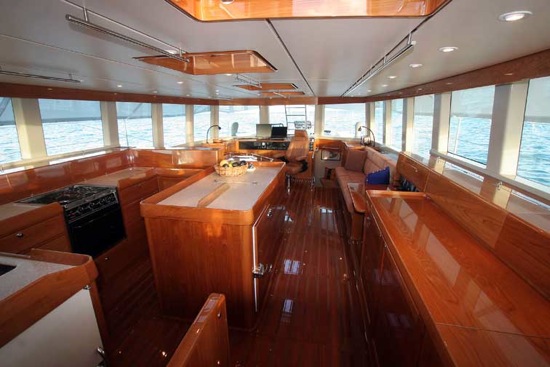
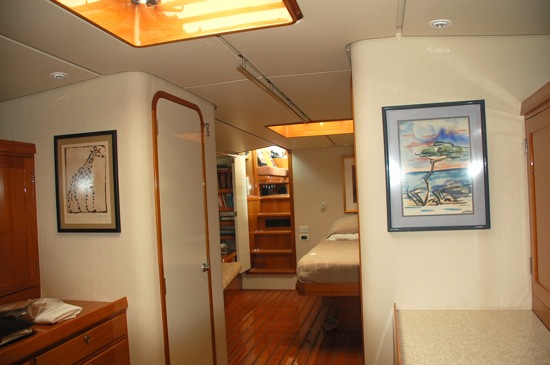
For as functionally metallic as she is on the outside, Wind Horse is comfortable and high tech within. Forward, to maximize natural ventilation, is the master stateroom. Aft are two guest cabins and the engine room. Amidships is dominated by a glass walled pilot house.
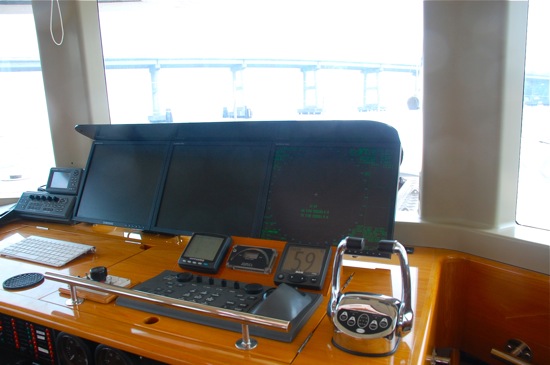
Inside the pilot house (Steve and Linda Dashew photo)The master stateroom: its forward location, and massive opening hatches, maximize natural air circulation at anchor.At the front of the pilothouse is the steering station. Here an array of radar, computer screens, digital readouts inform Steve and Linda everything about Wind Horse’s operation. Speed over ground, magnetic course, port engine temperature, starboard engine oil pressure. Everything a high tech boater would want to know.
The helmAnd herein lies the potential problem. While advances in technology and communications make it easier than ever for people to cast off their lines and put to sea, there’s a downside. “What’s been lost” says Steve, “is general seamanship.”
Enter the logbook.
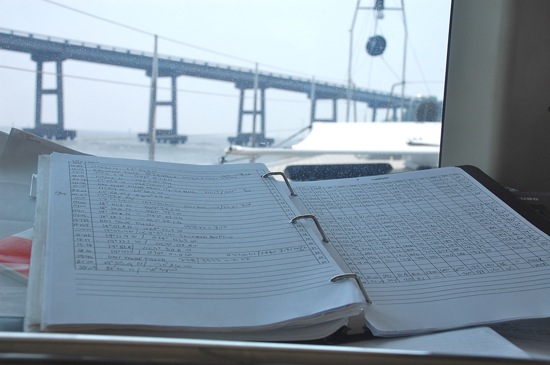
Off to the side of all the instruments dominating Wind Horse’s helm is a binder. Not a expensive leather covered logbook but a plastic D-ring binder filled with pages headed “COG”, “SOG” and “RPM”. It’s here where Steve and Linda keep a traditional written log while on passage. Generally once an hour, more or less often as needed, they record Wind Horse’s vitals: Course over ground, Speed over ground, Revolutions per minute.
Wind Horse’s log book. A black anchor ball, required of anchored vessels, is visible through the pilot house window.Deeper in Wind Horse’s interior, filed away for easy retrieval, is a collection of paper charts. While not fancy, all this paper serves as a simple backup in case of electrical failure. Or, as Steve only half jokingly notes, “we get hit by lightning….” Wind Horse also has a back up water supply organized. In rainy weather, deck water can be diverted to the main water tanks.
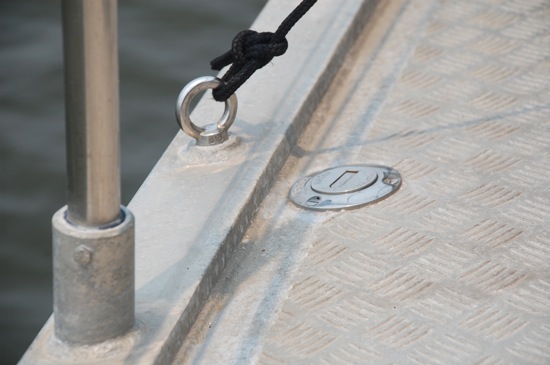
The circular fitting is a deck fill along one of Wind Horse’s gunwals. During rain showers, it can be used to divert rainwater into Wind Horse’s water tank.Many sailors dread the thought of changing from sail to power, seeing the transition as a compromise, a sell out. What do Steve and Linda think of swapping mast and sail for engine?
They’ve had 7 years to ponder it. Since launching Wind Horse in New Zealand, they’ve put over 50,000 miles under the keel. That’s the equivalent of traveling twice around the world – all without having to worry about checking rigging, stepping masts or hauling down sails in poor weather.
At a certain age, they’ve learned, that definitely has its advantages. They now both agree that voyaging under power “is just easier” than sailing. Even if doing it on their terms means showing up in Greenland on a vessel that’s been mistaken for a dredge.
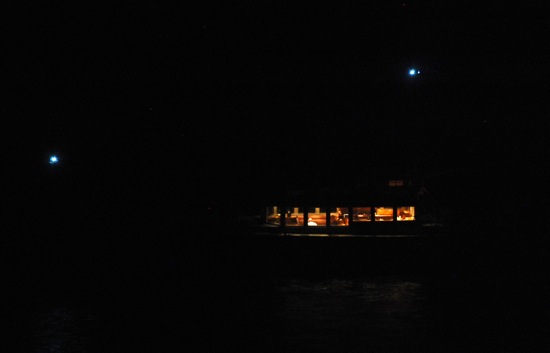
Wind Horse anchored in the night.From Oriental, Steve and Linda plan to head to Norfolk, and then north on a route TBD.
Posted Wednesday August 10, 2011 by Bernie Harberts


 • July 2026 - Marcel Lafond and SV Prospector • May 2026 - From Argentina to Whortonsville • February 2026 - Mads and SV Spiffy • July 2025 - John and the Birds • July 2025 - Capt. Carl Cannon Jr. & Pirate Ship “Adventure” • June 2025 - SV Mysto • March 2025 - 1926 Motor Yacht Mariner III • January 2025 - SV Skookum Takes On The World • November 2024 - SV Naia • March 2024 - Wes Barbour and SV Summer Wind • December 2023 - Pauline and SV Elektra • October 2023 - The Coati & The Mermaid • June 2023 - SV White Seal • April 2023 - SV Sarah G • March 2023 - SV Pepita • February 2023 - S/V Surprise • January 2023 - SV Thunderstriker • December 2022 - S/V Capitaine Bontems • November 2022 - Schooner Huron Jewel • July 2022 - Ashley, Apache, and SV Friends • February 2022 - Sam Rouse and SV Nortena • December 2021 - Coastal Conversations • February 2021 - Brother Sister Dory Story • December 2020 - Alan, David Bowie, and Blue 9 • November 2020 - Waiting for the Right Time • September 2020 - Camping in the Creeks • August 2020 - Solo Cruiser Emily Greenberg • June 2020 - SV Mudfog Cove Returns • March 2020 - SV Beyond • February 2020 - Shahid & SV Safina • January 2020 - Electric Vessel with Historic Roots • May 2019 - SV Misto Circumnavigates • April 2019 - MV Sea Glass