
It's Sunday September 6, 2026
News From The Village Updated Almost Daily
September 1, 2011
‹ previous page 1 2 3 4 5 6 7 8 next page ›
Oriental’s Marinas > River DunesAt River Dunes, JC Cappelmann, Director of Operations, says the 94 boats that were at the floating docks got through Hurricane Irene without damage.Irene had been a test, of sorts. Grace Harbor didn’t exist when Hurricane Isabel visited Pamlico County in 2003. So, Hurricane Irene was the first real trial for the marina at River Dunes. Cappelmann says that, “the marina did what it was supposed to do.”
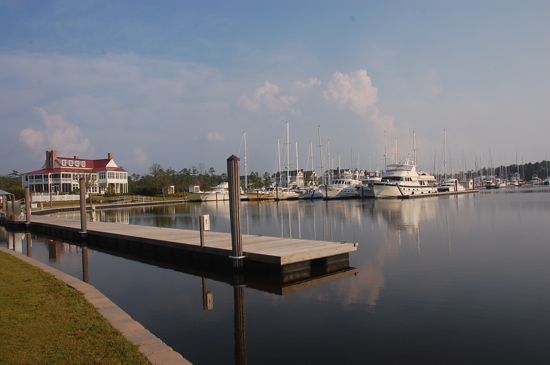 River Dunes Grace Harbor Marina.
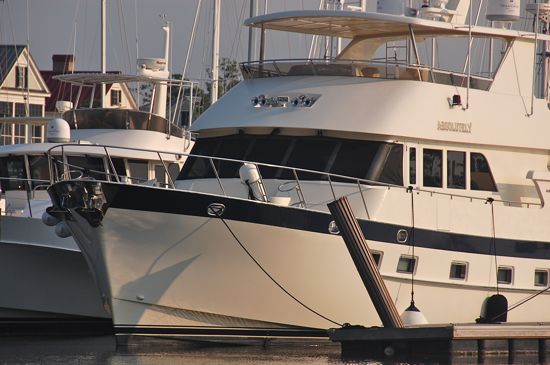 “Absolutely” is an 80-foot boat at RIver Dunes. This piling, closest to the entrance of River Dunes Grace Harbor, was damaged in the storm.
“I lost two pilings,” he says, noting that one was attached to an 80-foot boat straining in the 90-95mph winds. The pilings, on which the docks rise and fall, are 11 feet tall.
JC says he and his wife watched the storm from one of the homes on the harbor at River Dunes. The water came up slowly, he says, til it reached a level four feet below the cap of the pilings. Then, in just twenty minutes, he says, the water rushed in. It rose 2 more feet. The water level stayed two feet below the tops of the 11-foot tall pilings. In that, he says, the system worked.
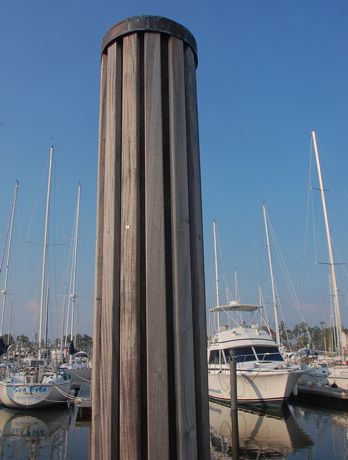 11 foot piling at River Dunes marina.
What if, we asked, a future hurricane brings a surge that is higher than the pilings that keep the floating docks in place? “If we go a couple of feet higher,” Cappelmann says, “we’d have a bigger problem and way bigger fish to fry in the county.”
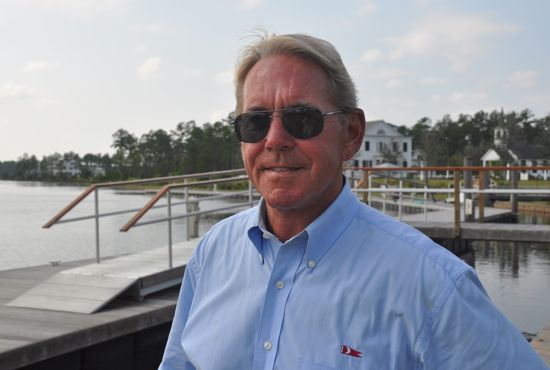 JC Cappelmann, Director of Operations at River Dunes Harbor Club and Grace Harbor Marina.
The River Dunes marina, Grace Harbor, is about half a decade old. It was man-made, scooped out of an area that charts called Gum Thicket and it has a canal that leads from the marina to Broad Creek. That one opening is to the northwest. River Dunes folks say that was by design as that wind direction is less problematic in hurricanes. Fetch is reduced as a result.
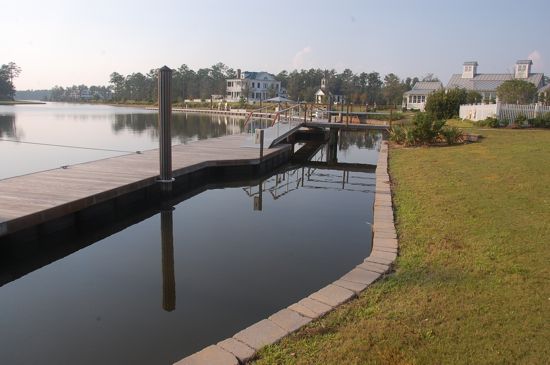 River Dunes Grace Harbor, in background is the canal leading to Broad Creek (and from there, the Pamlico Sound). It is positioned to the northwest. In foreground is the top of the bulkhead, which was engineered to let water seep in and out, and reduce the dramatic suction action when waters receded.
Around the edge of the harbor, the bulkheads are stacked stone, interwoven with kevlar. And for a dozen feet behind the bulkhead, and under the grass lawn, there is stone, all of which creates what JC Cappelmann says calls a big French drain. This system allows water a place to freely come and go, so that when the water drains, as it eventually does in a hurricane, it doesn’t exert the hydraulic pressure that often brings down other bulkhead walls.
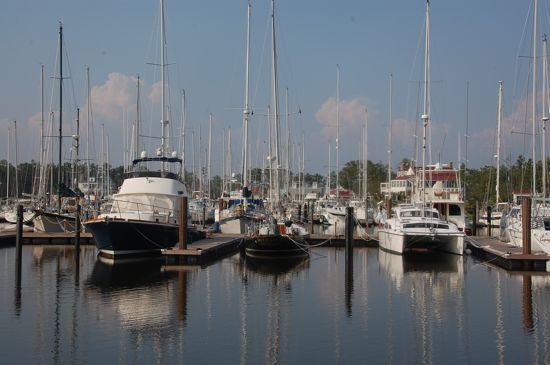 C Dock at River Dunes, closest to the entrance, just opened last week.
The marina had just opened slips at a new dock just last week. They needed them. JC says that he has about 40 boats in the slips all the time. 50 of them were here just for the hurricane. Ed Mitchell, the developer at River Dunes, says he had to turn boaters away.
As for Irene, JC says it “was a strong storm and a big storm.” The eye of it lasted so long, he says, he spent the time on a forklift, clearing debris from the area around the marina, until the backside of the hurricane kicked in.
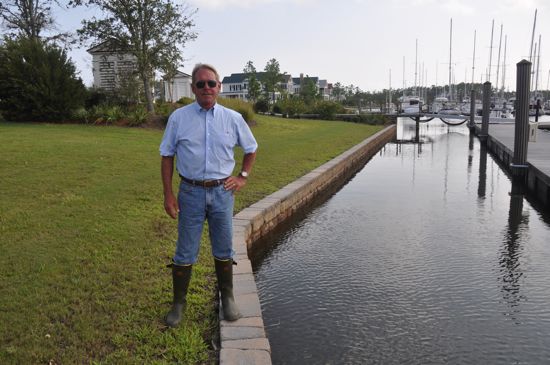 JC Cappelmann on the bulkhead at River Dunes Grace Harbor.
While it was the first hurricane for Grace Harbor, it was not JC Cappelmann’s first. He spent another career as a yacht master in the Caribbean and encountered a few hurricanes along the way. Most of those, though, were spent on the water and not on land. At sea, he says, you can at least ride out the storm.
‹ previous page 1 2 3 4 5 6 7 8 next page ›
Posted Thursday September 1, 2011 by Keith N. Smith

 • August 2026 - Brian James Hough, 1951 - 2026
• August 2026 - August Town Board Meeting 2026
• July 2026 - July 2026 Town Board Meeting
• July 2026 - CroakerFest 2026
• June 2026 - Thirteen Years of Silospalooza 2026
• June 2026 - June 2026 Town Board Meeting
• May 2026 - The Pig Celebrates 10 Years
• May 2026 - May 2026 Town Board Meeting
• May 2026 - NOAA's Prediction: A Below Average Hurricane Season
• April 2026 - Cycle NC 2026
• April 2026 - April Town Board Meeting 2026
• April 2026 - Zac Schnell, AI and Community Engagement
• April 2026 - The 2026 Oriental In-Water Boat Show
• April 2026 - Eston “Sherrill” Styron, 1942 - 2026
• April 2026 - Capsizing on the Creeks: SailPack 2026
• August 2026 - Brian James Hough, 1951 - 2026
• August 2026 - August Town Board Meeting 2026
• July 2026 - July 2026 Town Board Meeting
• July 2026 - CroakerFest 2026
• June 2026 - Thirteen Years of Silospalooza 2026
• June 2026 - June 2026 Town Board Meeting
• May 2026 - The Pig Celebrates 10 Years
• May 2026 - May 2026 Town Board Meeting
• May 2026 - NOAA's Prediction: A Below Average Hurricane Season
• April 2026 - Cycle NC 2026
• April 2026 - April Town Board Meeting 2026
• April 2026 - Zac Schnell, AI and Community Engagement
• April 2026 - The 2026 Oriental In-Water Boat Show
• April 2026 - Eston “Sherrill” Styron, 1942 - 2026
• April 2026 - Capsizing on the Creeks: SailPack 2026