
It's Friday June 5, 2026

News & Comment About The Issues Facing Oriental.
The Town Board holds Public Hearings on several important parts of the GMO regarding density and building size at a special Public Hearing on March 5.
This is an opportunity for the public to offer its views on the proposals put forth by the Stakeholders Advisory Group.
At the end of this report you can download those proposals to read for yourself.
Here is the background.
In late January, the Stakeholders Advisory Group formally made its recommendations to the Planning Board and Town Board. (A minority report was also presented, though its author was not allowed to deliver his report at that meeting.)
After several months of work, the SAG came up with some suggestions for changing the GMO’s Article XI. Article XI is the meat and potatoes part of the GMO. It deals with among other things, how far the building has to be set back from the property lines, how high the structure can be, how much land is needed if you want to put in multi-units – condos or townhomes.
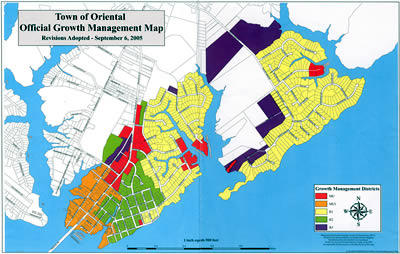
This most pertinent part of the GMO came under review in the middle of last year after a rash of permits was granted for developers to build condos in town. Under the existing formula, they could build them at a density of almost 14 units per acre. (The formula called for 5,000 square feet of land for the first unit and just 3,000 for any subsequent unit in the MU, MU1, R3 neighborhoods. In the R2, which with the MU1 makes up the Old Village, only duplexes were allowed, again under the 5,000/3,000 formula.)
The GMO map below shows where the lines of these neighborhoods are drawn:
In late summer and early fall, there were several proposals on the table for reducing density by changing that formula and making other fine-tunings to the GMO.
In October, the Town Board voted to change the formulas to 6,000/6,000 in the R2 and 5,000/4,000 in the R3, MU and MU1 neighborhoods. But instead of taking permanent action, the Town Board made that only a temporary measure, lasting until March 7th. (Another public hearing on March 5 will address whether to keep those in place.)
At that time, the Town Board also chose a wait-and-see policy on proposals to tighten the GMO regarding setbacks, lot size, maximum building size. Instead of acting on the proposals before them then, the Town Board assented to the pressure from several representatives of Oriental’s real-estate and development industry and Mayor Sherrill Styron and Commissioner Candy Bohmert, to set up a group of what were to be called “Stakeholders”.
What is a “Stakeholder”?
The term was loosely defined, though Commissioner Bohmert and the mayor signaled that they thought those who owned significant property should have a seat at the table to decide how that property would be regulated.
The Stakeholders Advisory Group itself was also loosely organized, with few guidelines in place. There were, for instance, no stipulations on what each stakeholder should represent. Instead, each town board member simply chose an appointee.
Mayor Sherrill Styron chose fellow commercial seafood plant operator and fellow large harborfront landowner, Chris Fulcher. Candy Bohmert chose developer Henry Frazer, who like the mayor and Mr. Fulcher, owns a number of investment properties in the MU1 area. Al Herlands chose Sally Belangia, who runs the First Citizens Bank. Warren Johnson chose Yvonne Jones, who works for the county social services department. Barbara Venturi chose Kathy Enzerink, a retired Christmas tree farmer. Nancy Inger chose George Smith, a retired Progress Energy engineer. (Mr. Smith led the charge against the Whittaker Creek Condo project in his neighborhood).
Little attention was paid to geographic representation. Five of the six Stakeholders live in the outlying R1 neigbhorhoods. One lives in an R3 neighborhood. There was no representation from anyone who lives in the R2 nor the MU1 neighborhoods of the Old Village, the part of town whose look and character many believe has been most imperiled by the high density and blocky construction.
Though no R2 or MU1 residents had a place at the table, there was representation for those, such as Mr. Frazer and Mr. Fulcher who own significant land holdings in the MU1. The concept of “return on investment” was brought up as the SAG discussed density.
Initially, the entire group sought to meet in private, until two media organizations (TownDock.net and the Pamlico News newspaper) noted that NC’s Open Meetings Law clearly states that such meetings have to be held where the public could attend them.
The SAG met twice a week for several months, but chose not to meet at the Town Hall as virtually every other town appointed group does. Instead, the SAG met in the back room of the Village Restaurant (a building Mr. Frazer owns).
SAG member George Smith drew up proposed changes to Article XI to get at what he said was the problem of “too big a building on too small a lot.” He laid out tables calling for greater setbacks from the sidelines the higher the building went. He and Kathy Enzerink called for a maximum building size, no matter the lot size. As the work went on, there was resistance from Chris Fulcher and Sally Belangia who said they thought the GMO was fine the way it was.
The mayor, who owns 2 acres of MU1 land on the harbor, attended a numer of the sessions and said at one meeting that George Smith’s plan would “destroy property values”. He offered no evidence to back up that claim.
“Encouraging Business”
As its discussions carried on, the SAG devoted attention to “encouraging business in the MU and MU1”. The need to do so was never empirically spelled out, yet it became the thrust of many discussions. In the end, it would run counter to the SAG’s primary stated task of reducing density.The “encouraging business” propsals often did not seem targeted at how to help a business set up up or continue operation, but rather seemed more focused on the business of the the one-time sale of property.
Henry Frazer came up with a rewrite of a section of Article XI that would have required — NO — minimum lot size if someone said a percentage of the condo complex would have a commercial use. That was said to be a way of “encouraging business.”
That was later amended to having a 5,000/3,000 formula in the MU1 if some of the units were to be non-residential. (The proposal does not address exactly how the town will police the use of units to make sure they are used for the business that was to be encouraged, and not for example, as condos.) 5,000/3,000 in the MU1 would mark a return to the old density rules on land owned by Mr. Frazer, Mr. Fulcher and Mayor Styron.
In the end, George Smith said that “my conscience would not let me” agree to that and a few other provisions that the rest of the SAG was proposing. He drafted a Minority Report. At the SAG’s last meeting on January 23rd, there was agreement around the table that Mr. Smith would deliver his minority report after the majority delivered theirs the next night, to the Planning and Town Boards.
But a few hours before the meeting, Mr. Smith received an email from Town Manager Wyatt Cutler informing him that it was the “consensus” of a “number of participants” that the Majority’s report was “the only one that should be presented tonight”. Mr. Smith’s minority report, Wyatt Cutler wrote, “will be distributed and can be addressed at a public hearing.”
At the meeting, Planning Commissioner Dave Cox moved to have Mr. Smith’s report presented that evening. However the SAG members, who a night earlier had agreed to let Mr. Smith speak, remained quiet and would not agree to have the minority report presented.
George Smith says he found an irony in that, given that the entire premise for setting up the SAG was to give voice to some elements in town – the development and real-estate industry – who claimed they were not being heard. When it came time to issue reports, a minority within that SAG group was prevented from speaking out.
Mr. Smith’s minority report is however, part of the record now and is one of several reports before the Planning Board and Town Board. You can now also see both here. Also, to further illustrate the difference between the two plans, George Smith has provided a sketch of what can be built on the School House Condo lot under his plan and under the Majority plan.
Three Main Differences Between the Majority and Minority Reports:
1. Density Formula For MU1. Mr. Smith calls for a 5,000/4,000 minimum lot size formula in the MU1 regardless of whether it will be business or residential construction. The Majority’s plan would mark a return to the 5,000/3,000 density that had many in town last year clamoring for something to be done. Mr. Smith’s plan would reduce density from what it was a year ago (5,000/3,000) Also, Mr. Smith’s plan would not require usage police to make sure someone isn’t as, Mr. Smith sees it, gaming the system as could happen under the SAG Majority’s 5,000/3,000-if-you-say-part-will-be-commercial plan.2. Maximum Building Size. This would be a new element in the GMO. It was conceived as a way to avoid large blocks of building. (For reference, one of the new Oriental Harbor Place condo buildings is 10,000 square feet.) In the MU1 (where two of the stakeholders own extensive investment property) the Majority voted to have an 8,000 square foot limit. Mr. Smith’s minority report would have a 6,000 square foot limit. (Mrs. Enzerink said she wanted a 5,000 square foot limit, but voted with the majority.)
3. Setbacks. The majority’s plan would keep the 7-foot side setback rule and require three more feet of setback for buildings whose eave is greater than 25 feet above grade. Mr. Smith’s plan calls for 10 foot setbacks from the side for starters (to abide by another rule in the GMO in place to assure firemen’s ladders have adequate foothold) His plan would also require six more feet (for 16 feet of setback) for buildings with eaves greater than 25 feet above grade.
The Town Board will hear public comment on these proposals at public hearings on March 5th. The meeting is 7pm, and currently scheduled to take place at Town Hall.
Reports:
The SAG Majority Report. Click here to download the report.
The SAG Minority Report. Click here to download the report.
Note: The Planning Board may offer a list of their own recommendations on how to reduce density; The Public may also comment on those at the public hearing on March 5th. We’ll have that story here in advance of the meeting.

Posted Tuesday February 13, 2007 by Melinda Penkava


