
It's Sunday May 3, 2026

Lots of boats come to Oriental, some tie up at the Town Dock for a night or two, others drop anchor in the harbor for a while. If you've spent any time on the water you know that every boat has a story. The Shipping News on TownDock.net brings you the stories of the boats that have visited recently.
February 6, 2006
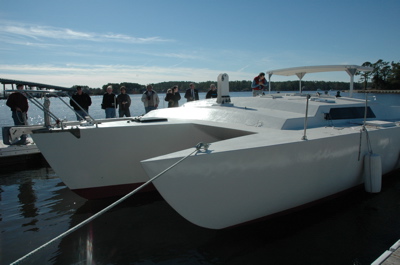
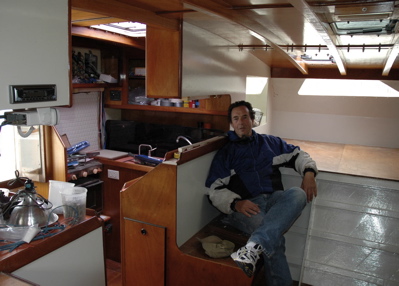
At last Michael Projansky has his 40-foot Norman Cross trimaran in to the water.
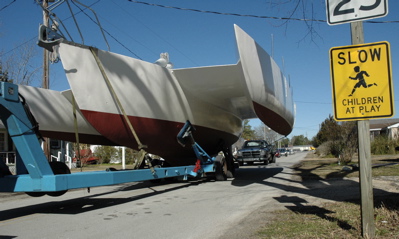
The launch came on the last Friday in January, at the Wildlife Ramp in Oriental. A small parade of friends helped — leading the way and following the triple-hulled wooden ketch as it made its way eight-tenths of a mile down Midyette Street from Paul Welles’ boat yard.In terms of asphalt covered, it’s a short trip. Just five blocks. And that flat terrain of Midyette Street is a far cry from hauling a boat up a mountain as in “Fitzcarraldo”. But still, Michael says, it brought tears to his eyes, because the “getting there” has been a long, long trip.
When he bought the boat, Michael thought it might take him two winters to get it in to the water. That was in 2000. Instead, Michael, who works during the summers captaining a boat in New England, has spent the past half dozen winters in Oriental. He, and his blue van — losing more paint every year — have become a part of the winter scape here.Getting the boat back in to the water is a story of lust and wood rot. A sense of being cursed… and at the same time, grateful.
Michael first met the boat in Vandemere. In the summer of 2000 he had been reading a multihull magainze and saw an ad for a Norman Cross. He’d wanted one for years. It was the boat of his dreams. Or as he clarifies, the “boat of my dreams.. that I could afford.” He had the idea that he’d sail it to the islands and run charters from there.
Actually, it went beyond simply wanting one of these trimarans. Michael uses another word to describe what made him buy the boat. “I had lust for a 40-foot Cross.”
As Michael recalls the boat ad, it spoke of the 40-foot trimaran needing “$3,000 in parts and two months work and it’s ready to go”. Thus tempted, he traveled to NC to check it out….and immediately saw that it would take more money and time than that.
The boat had been on land when waters rose during hurricane flooding in the late ’90’s. The boat had gotten got “banged around,” he says. When Michael saw it, a year or two later, the impact of the flood on the boat was clear: Missing hatches. A busted rudder. Standing water in the bilge. Holes. Rot. And rather problematically, no keel.
“Anybody in their right mind,” Michael says, “would have walked away.”
But two things kept conventional wisdom at bay. For one, Michael says that his take on life is that “I don’t like to see things go to waste.” For another, this was the kind of boat — if not the condition — he’d dreamed of owning.
So instead of leaving Vandemere right away, he stayed and slept on the idea. He went to bed that night telling himself he shouldn’t buy it, and practicing the word “no” in his head over and over.
It didn’t work.
In the morning, the couple trying to sell the boat posed a tantalizing question. Michael says they asked him how much he thought the parts of the boat were worth. There were, after all, new sails, complete rigging and an engine that ran on the 40 × 21 foot vessel. The owners lowered their asking price significantly – to $2,500.And then Michael says he counteroffered…upward. He offered $5,000, he says, for two reasons. For one, he says he “didn’t want to take advantage of their bad luck” at having had the boat so damaged in the hurricane flood.
And the second reason, he says, was that he “didn’t want to tell the boat its hull was useless.”
Which was important because the boat was now his. He had the boat he’d “lusted for”.
——-
What put Michael on the path toward this particular kind of boat was a trip he took in the mid-80’s to the British Virgin Islands. He was in his mid-forties and had never sailed before. When he grew up in White Plains, NY he says, sailing was not something everybody did or could do. His ‘sailing’ he says, was limited to the Staten Island Ferry.
So, on a whim, while in the BVI, he went for a day-sail. It was on a stout double-ender, a Colin Archer designed ketch. Traditionally rigged and slow, it moved along at 6 knots and as it did a beam reach up the channel in Tortola, Michael says, it felt like an addiction had set in. “When they put me at the helm I just got it in my body.”[page]
Two days later, in St. Johns, he spied another boat at anchor that looked like a manta ray. I said, “My God, what is that??”
The man with the boat said it was a Dick Newick trimaran. 38 feet long, it had won the 30-40 foot class in the 1980 O-Star race and come in 5th overall. He invited Michael for a sail.
The trimaran owner sent Michael to the bowsprit, telling him “It’s a good place to watch from.” He raised anchor, backfilled his jib and they sailed off. They pretty quickly attained speeds three times that of the double-ender from two days earlier. At one point, Michael says, they were doing 21 knots on a beam reach from St. Johns to Jost Van Dyke.And with that, another addiction was born, not just for sailing itself, but for the speedy trimarans.
The owner of the Newick tri sensed it, too. “On the way back he said to me, ‘I’ve done you a great disservice. I can see you’re addicted. And for the rest of your life you’ll compare all boats to this one. And all the others will seem like dogs.’”
Michael says that’s pretty much been true, with only a few exceptions.
Nonetheless, those 2 sails in the BVI marked a change in Michael’s life. Within a few years he had quit his job as a clinical psychologist and was making boat deliveries. In the late 90’s he started the job he still has, skippering a sailboat in New England during the summer months.
And all along, an idea kept churning: that he would someday buy a trimaran and do charters in the Caribbean. In particular, he says, he’d like to offer some charters where people could experience sailing without, as he put is , “ a whole lot of noise.” Cruises where “I could take them out and not say a word.” so that people could more truly experience it .
But to do charters of any kind — talk-free or non — he wanted a Norman Cross. He was drawn to it for the sleekness of its design and for the space it could offer as a charter boat. Which is why he was so “in lust” with the boat he found — with all its flaws — in Vandemere in 2000.——————————-
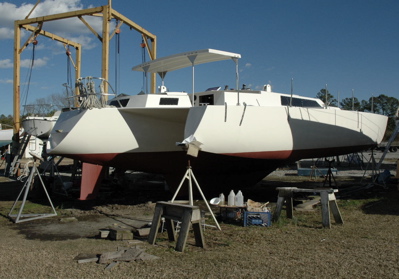
Having bought the boat, he had Paul Welles truck it down to his Triton boatyard on MIdyette Street in Orienal. And he began work. From square one.
“I had no experience working on boats. None,” Michael says. But he figured that with “perseverence and picking people’s brains,” he could make it work. He just didn’t realize how much perseverence that would take. And how his boat would become a fixture next to the Travel Lift.
As any boatowner knows, things always take longer in “maritime” and new challenges always present themselves. And this boat had plenty to start with.
Rot became a persistent problem with the cold molded plywood hull. The 3/8ths inch wooden hull was susceptible to it. As Michael says, “It’s a good boat, it’s just made out of the wrong material.” To fix it, Michael would triple-sheath areas of the hull, laying strips of ply diagonally and epoxying them. And then more rot would turn up in another spot, and he’d do the process again. And again. This was happening because, even though the boat was on the hard, water was finding its way in.
Fresh water, Michael says, was not his friend. And in retrospect, he says he could have avoided it.
[page]
The first mistake he says, was buying the boat. The second: that he didn’t build a structure around the boat to keep the rain off of it. A tarp and frame, he estimates, would have helped him finish the boat two years earlier.
He figures he lost 30-35% of those 6 winters because he was doing the work out in the elements. “When it rains, you have to wait to let it dry before you epoxy, and then you need two (dry) days to let it kick. And it rains a lot in NC.”
Though only 9500 pounds, the boat weighed heavily on Michael as two years grew to three and four and five. In the last few years, friends sensed that the project and its rot problems were becoming overwhelming.
“Paul Welles didn’t think I’d do it. He said he thought I’d have to cut it up some day.”
“And there were times when I thought it was cursed. I’d come back each fall and think I could get the boat in the water in 2-3 months and then discover some problem like rot and it would be a 2-3 month ordeal,” just to address that newly found problem.
“I almost burned it. Twice.” Michael pauses. “But I didn’t buy any matches.”
He jokes that he did think of naming the boat, ‘Sisyphus” after the Greek mythological character condemned to the useless task of rolling a rock up a hill forever. The boatwork was like that. “It felt endless.”
In terms of money, Michael isn’t saying how much he’s spent restoring the boat. “I willfully made a decision to stop counting at thirty,” a point he intimates he has passed. “I don’t want to know what it’s costing,” in money, labor, and lost income.Though not precise on the figures, he is certain of one thing: “Buying the boat was the worst financial decision I’d ever made.”
Time in a boatyard leads a mind to wander and travel through Woulda-coulda-shoulda-Land. Shortly after he bought this Norman Cross-designed boat, he saw another for sale. It was in better condition.. but more expensive. In retrospect, he wonders if he’d have been better off borrowing money to buy it. “Because then I could have spent the past six winters chartering, and making money… rather than riding the grinder” in Oriental.
During one of those Oriental winters, he weighed the financial cost of continuing versus the emotional cost to either continue or quit.
“And I came to realize I had to complete it. I’d caught a tiger by the tail. I had no choice. It’s not a financial question. It’s a question of self-definition.”
“The boat,” he says, “had become a symbol of myself.” Just as there are “rotten things” in his own life that were still worth reclaiming, he reasoned, so too with the boat.
“Certain things you can walk away from. Others you can’t.” Michael says. Despite thinking his boat cursed, he says he is glad he stayed and completed it.
He speaks too of the friends made in Oriental over the last 6 winters. And he notes, “I’m not afraid of any boat as I was before. I got good with the grinder. I know I can take a grinder or a Sawzall and always fix it.”
Just to be sure we ask if he’d do it all over again. The answer is quick. “Absolutely not”
“I would’ve preferred the two-months and 3-thousand dollar option…”
———
On Friday January 27th, at about 1 in the afternoon, with a few dozen friends and family on hand, Michael’s boat began the slow roll down Midyette Street to the Wildlife Ramp.Michael says that on the slow crawl down Midyette Street, “I was sobbing,” thinking on all the effort and energy and years that went in to bringing the boat this far.
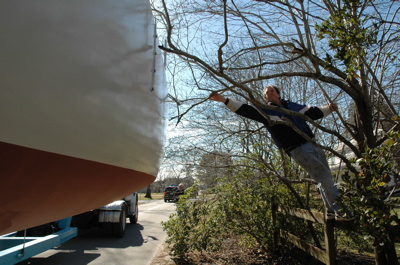
Those moments of reflection were punctuated by occasional stops along the five-block route. He had to push back crape myrtle and dogwood trees whose bare upper branches were reaching out to the lifeline stanchions. (Some quick ladder work by Jimmy Zeman took care of the land-based navigational hazards.)
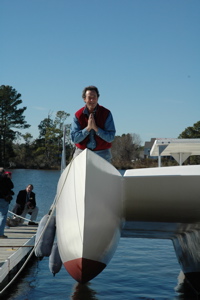
And then, the boat was at the launch ramp. The wind had been out of the south, more so than usual and that lowered the water level. This gave a few moments of pause as Paul Welles backed the truck up, wanting the boat’s rudder to make it to the deeper water of the ramp while at the same time not losing his trailer over the underwater “cliff”. Michael meanwhile, assumed a prayer pose more than once.
And then finally, after so many years, the boat was floating again.
For some who’d watched Michael’s challenges with the boat during those Winters of Discontent, the boat in the water took on a different look. Things seemed possible, places to go, pure sailing and chartering, his initial reason for getting the boat.
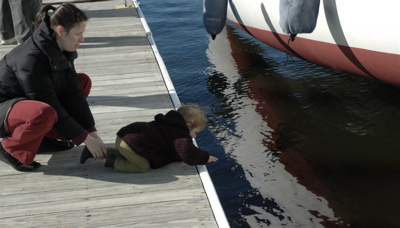
But while he plans to bring the boat to the islands and charter her starting in the fall, Michael’s no longer cerrtain that he wants to spend five months of the winters there. A year and a half ago, Michael became a grandfather. And he wants to be able to visit his grandson in upstate NY. (Fifteen-month old Asher was on hand for the boat launch and, getting an earlier start than his grandfather in being around boats, showed an affinity for water.)
“I have this very strong fantasy,” Michael says, “of teaching my grandchildren to sail. Asher is 15 months old now. But 8-9 years from now, I don’t know if I’ll be messing with a boat.
As for the boat, he’s not certain what he’ll name it. He told friends at the boat ramp that he was going to name it “Maruti” which in Sanskrit means, “Son of the Wind”. (Some of the less-enlightened among Michael’s friends had to wonder if other lineages came to mind over the past 6 years….)
Maruti is the name Michael himself received on a pilgrimage to India 30 years ago. But the MV Maruti is not a lock. A few days after the launch, he was weighing another name: “Gratitude”. He envisions people seeing that name on the transom and taking stock of what they have, to “remind them.. to ring a bell.”
As for Michael, he says he’s grateful that the boat is completed, that he didn’t hurt himself in fixing it up and that he’s “pleased when he looks at it.”
It was lust, he says, that got him to buy the boat. So, does he love it now? A week after getting it in the water and getting the masts up, he doesn’t know. “I might come to love it. I will when I can sail it.”
Posted Monday February 6, 2006 by Keith N. Smith


 • February 2026 - Mads and SV Spiffy • July 2025 - John and the Birds • July 2025 - Capt. Carl Cannon Jr. & Pirate Ship “Adventure” • June 2025 - SV Mysto • March 2025 - 1926 Motor Yacht Mariner III • January 2025 - SV Skookum Takes On The World • November 2024 - SV Naia • March 2024 - Wes Barbour and SV Summer Wind • December 2023 - Pauline and SV Elektra • October 2023 - The Coati & The Mermaid • June 2023 - SV White Seal • April 2023 - SV Sarah G • March 2023 - SV Pepita • February 2023 - S/V Surprise • January 2023 - SV Thunderstriker • December 2022 - S/V Capitaine Bontems • November 2022 - Schooner Huron Jewel • July 2022 - Ashley, Apache, and SV Friends • February 2022 - Sam Rouse and SV Nortena • December 2021 - Coastal Conversations • February 2021 - Brother Sister Dory Story • December 2020 - Alan, David Bowie, and Blue 9 • November 2020 - Waiting for the Right Time • September 2020 - Camping in the Creeks • August 2020 - Solo Cruiser Emily Greenberg • June 2020 - SV Mudfog Cove Returns • March 2020 - SV Beyond • February 2020 - Shahid & SV Safina • January 2020 - Electric Vessel with Historic Roots • May 2019 - SV Misto Circumnavigates • April 2019 - MV Sea Glass • March 2019 - Steve Chard: Kayaking the Great Loop • January 2019 - Holly Martin and SV Gecko