
It's Friday May 22, 2026

Lots of boats come to Oriental, some tie up at the Town Dock for a night or two, others drop anchor in the harbor for a while. If you've spent any time on the water you know that every boat has a story. The Shipping News on TownDock.net brings you the stories of the boats that have visited recently.
May 14, 2004
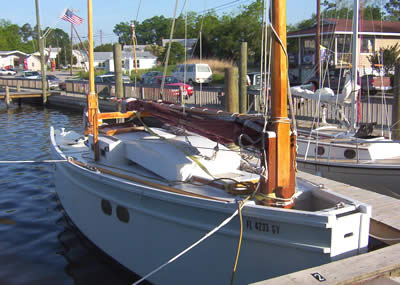
Adog and allergies prompted John Dalziel to go to sea and to wind up, in mid-May, in Oriental. But more about that story in a moment. It’s the boat he sailed in on – “Zoella” – which initially caught the eye. John says he gets that a lot.
“It’s an attention getter,” John says. “Not outrageous, but just… odd. A lot of people assume it’s an antique.”When folks ask John when it was built, he can tell them, truthfully, that “Zoella” was built around ’92-‘94. They just might assume he means 1892. In fact the boat was built only a decade ago.
What gives that impression of being older is all that varnished wood and “Zoella’s” rather straight lines. There’s no curving hull. Her slab-sides run straight from the deck to the water.
“Zoella” is one of what the designer Phil Bolger of Gloucester, Mass calls his “square boats.” Bolger drew plans for some 20 types of square boats, with the backyard boat builder in mind. John Dalziel says about a dozen boats like “Zoella” were built.
She’s Bolger’s AS29 model. The AS stands for Advanced Sharpie, but that, John says, is a bit of a misnomer. Phil Bolger based his boat plans on the Sharpies that were originally built in New Haven, Connecticut in the 1800’s (and which inspired the Beaufort, NC area Sharpies.) In terms of proportion, John Dalziel says, the AS29 is too wide (at 8 feet) for its length (29 feet) to be a Sharpie.
And yet, John says, with her flat-bottom and 13 inch draft, the AS29, “does the job the Sharpie does in sailing in shallow waters”. And that was one of the attractions for him.Another distinctive Phil Bolger feature is found at the bow. .
At the very fore of the boat, there is an anchor well about four feet deep and big enough for John to stand in. The forward section of that well — the very front of the boat — is a door, much like you’d find in a companionway. John showed how he could lift that door up, which in effect opens the front of the boat above the waterline.
That now open space allows room for the bottom end of the mast to swing out forward when John leans the mast back on its tabernacle. That design was inspired, John says, by barge ships on the Thames in England in the days before auxiliary motors. They’d drop the masts as they neared bridge, float under and then raise the masts again.
On his journey up the ICW, John has done the same. The easy-to-use tabernacle has come in handy for him when he’s not wanted to wait for bridge openings on the Waterway. In a couple of minutes, he can have the masts down and lying aft and then can pass under. Unlike the Thames ships he sometimes uses his 9HP outboard.That pull-away door on the bow has another benefit. With the boat’s flat bottom, John says he sometimes sails it up on to beaches and then can step right out of the front anchor well on to dry land.
So how did he decide he wanted to live on a boat?
He sailed some as a kid growing up in Colorado. And about ten years ago, he built a 19-foot Polynesian flying proa, a sailing outrigger canoe. “It didn’t tack” John says. Instead, when you wanted to change your course, “the stern became the bow.” It was he says, “light and simple and well-thought out.”
But the inspiration to go off and acctually live on a boat came a few years later.
John says he was caring for an ailing aunt. After she passed away, he had to take care of her affairs, and that included her dog. And that is when John learned that he was allergic to the dog. He pretty quickly developed what he called, “24-hour-a-day-asthma.” Though he was eventually cured, he decided to take the serious illness as a sign: that if there was anything he wanted to do, he should do it while he was still healthy.
That sent him looking for a boat to live on. He initially sought a 35-footer.
But on the Internet he found “Zoella”. She’d been sitting in a field in Mississippi for four years after the man who built it in the early 90’s got ill. The boat, John says, had so many good features. He says it has “a lot of space for the size” including a queen sized bed aft.
Indeed, a visit down below finds a lot more space than you’d expect. One reason may be that, as John put it, there’s about an inch of cabin floor between your feet and the water. No space is wasted.
After its stint in the Mississippi fields, “Zoella” required a little bit of work.. John says he replaced 25% of the deck and fixed some of the hull. One thing he didn’t change was the boat name; the builder of the boat had decided that the boat looked old-fashioned and that reminded him of his grandmother. Her name was Zoella. He also kept the table leg that doubles as a cat scratching post, very nautically wrapped in white and red line. (The man who built the boat and his wife had lived aboard for several years with what John says was a very wild cat.)
John moved aboard “Zoella” two and a half years ago.
He didn’t do much traveling right away. His father in Florida was ill with Parkinson’s disease. John sailed “Zoella” down the Tennessee-TomBigBee waterway to the Gulf and Panama City, Florida. His father’s house was on a creek there, and on a high tide John sailed the boat on to land near a bayou and called that home for the last years of his father’s life.Last year he began making his way up the East Coast for the first time. He mainly travels inside the ICW but does some sailing along the coast, though not far from shore. “I pick the weather carefully,” he says. The boat’s shallow keel, an advantage in getting up creeks, can make it more tentative out in waves. “Every wave, “ says John, “makes a different pattern on the rudder.”
John got as far as Brunswick, GA last year. And this year he’s aiming to get to Maryland for the summer where a friend may help him work on a Chinese junk sail for the mizzen. It’s not something Phil Bolger approves of, John says, but he’s found he needs a faster system for getting the sail up – and down — than the original system.
He’s also testing whether he will continue living on the boat. “If I like it, if I like what’s going on” he says, he’ll continue. So far, he says he’s inclined to.
The adjustment to life on the boat these past two years has been relatively easy, John says. That may be because his career before this had been “little of this, a little of that.” As a result, John says, “Being on a boat isn’t such a stretch.”
An amateur skater when he was younger, John taught figure skating for 13 years. For another 8 years he had a company that made a line of model railroad kits. Not the trains themselves, he says, but “the house kits that people put on their layouts”. He got started in that business by making the miniature trees – “the lady who was doing them died,” he says and there was still a demand. He found that it paid the bills.Ultimately though, says John, making the kits “got repetitive after 8 years”. If he had to get in the models business again, he says, he’d sell boat models.
But not the real boats. Even though he owns one of the more recognizable and distinctive homebuilt boats — and even though he made the proa — John says he’s not inclined to build another boat.
“Making real boats is not good business,” he says. “The trouble is, you never get your money back. “ He estimates that the man who built his boat spent $30,000 dollars on materials, and sold it to him for $8,000. He then put another $12K in to it to get it ready to sail. He may not recoup it, he says, but figures that he’s had a great place to live for at least the past three years.


Posted Friday May 14, 2004 by Melinda Penkava


 • May 2026 - From Argentina to Whortonsville • February 2026 - Mads and SV Spiffy • July 2025 - John and the Birds • July 2025 - Capt. Carl Cannon Jr. & Pirate Ship “Adventure” • June 2025 - SV Mysto • March 2025 - 1926 Motor Yacht Mariner III • January 2025 - SV Skookum Takes On The World • November 2024 - SV Naia • March 2024 - Wes Barbour and SV Summer Wind • December 2023 - Pauline and SV Elektra • October 2023 - The Coati & The Mermaid • June 2023 - SV White Seal • April 2023 - SV Sarah G • March 2023 - SV Pepita • February 2023 - S/V Surprise • January 2023 - SV Thunderstriker • December 2022 - S/V Capitaine Bontems • November 2022 - Schooner Huron Jewel • July 2022 - Ashley, Apache, and SV Friends • February 2022 - Sam Rouse and SV Nortena • December 2021 - Coastal Conversations • February 2021 - Brother Sister Dory Story • December 2020 - Alan, David Bowie, and Blue 9 • November 2020 - Waiting for the Right Time • September 2020 - Camping in the Creeks • August 2020 - Solo Cruiser Emily Greenberg • June 2020 - SV Mudfog Cove Returns • March 2020 - SV Beyond • February 2020 - Shahid & SV Safina • January 2020 - Electric Vessel with Historic Roots • May 2019 - SV Misto Circumnavigates • April 2019 - MV Sea Glass • March 2019 - Steve Chard: Kayaking the Great Loop