
It's Friday October 2, 2026
News From The Village Updated Almost Daily

Lots of boats come to Oriental, some tie up at the Town Dock for a night or two, others drop anchor in the harbor for a while. If you've spent any time on the water you know that every boat has a story. The Shipping News on TownDock.net brings you the stories of the boats that have visited recently.
February 12, 2004
Sean Prendergast was digging a hole near the SailCraft Boat Yard. Actually, it was more than a hole. It was a 5 by 10 foot section under the dock and in early January, Sean’s job was to dig out the several feet of dirt that had silted in there. The task grew tougher the deeper down he got – the silt was heavier, the distance he had to bring it to ground level, ever higher.
It was a far cry from the job he once had of reporting on Congressional hearings. And at one point in the middle of it all, someone asked Sean how he came to be doing that job.
“I failed,” he said, “to reef a foresail.”
In December, the sailboat that Sean and his girlfriend Esther Granville were sailing on dismasted in the Neuse River.
Esther onboard Sea Otter when they first arrived in December (note the broken mast).But their story and how they came to be in Oriental goes farther back than that gusty day in December.
A decade earlier, when Sean was around 12 or 13, he says, a neighbor of his grandmothers threw away a Sunfish sailboat. Literally put it out by the curb to be hauled away with the trash. Sean grabbed it as his own.
The boat needed a few repairs and Sean says he would wait till his parents left the house and then bring out the power tools they wouldn’t let him use otherwise. He sailed the boat as much as he could on a lake near his home in Shrewsbury, Massachusetts.
He has been drawn to boats ever since. He attended college for a while in St. Thomas and worked as crew on a charter boat. A while back he was offered a job in the Hinckley Boatyard in Maine, but around that same time he got a job offer in Washington in Senator Ted Kennedy’s office. Sean’s parents prevailed upon him to take the job in DC, which in their view was a better use of his college years studying journalism. He reluctantly did and found himself sitting for hours in Congressional hearings and then preparing one-page summaries. He tired of it quickly and left after a few months.
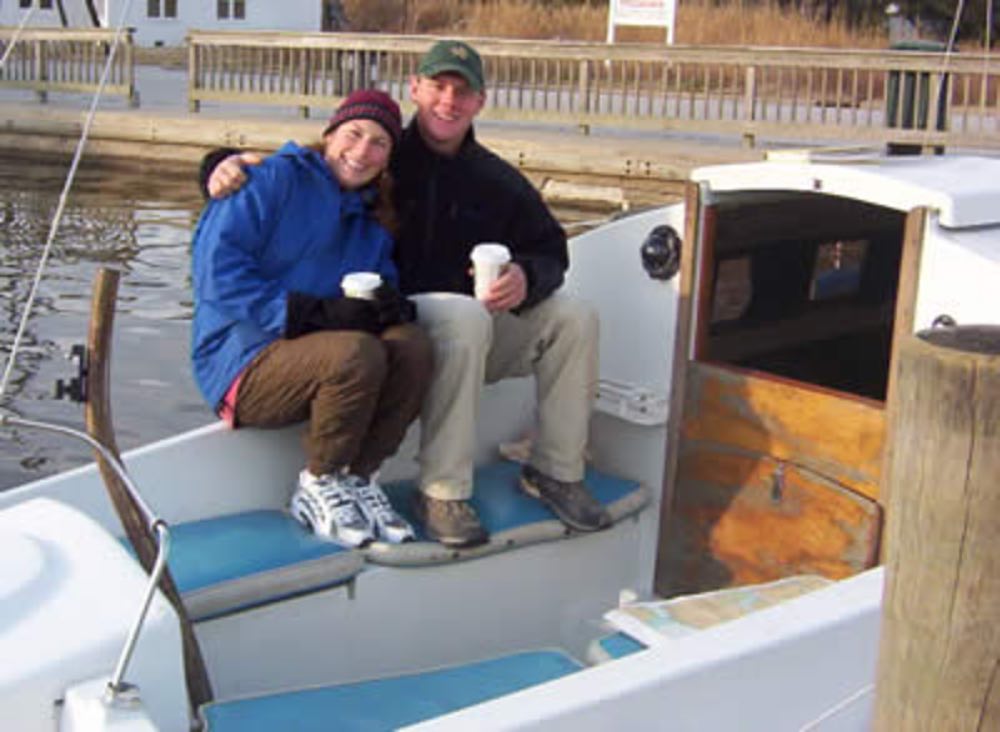
Sean & EstherThe pull to boats was still there when he graduated the University of Maine with Esther last May. Esther, who is from Mansfield, Connecticut, had little experience sailng, yet the two talked about getting a sailboat and going to Sean’s old sailing grounds in St. Thomas on it. Right after graduation, they even looked at a boat in Noank, CT — a little twin-keeler — but decided they’d wait on land a few years.
But a short time later they heard about a boat auction near Mystic, Connecticut. They went, they say, only to “go watch for fun.” Once there, though, Sean and Esther saw the boat they’d looked at earlier. It was a 26-foot Snapdragon, a British built boat with a bilge – or twin—keel. It was named Sea Otter and had been built in 1967. In that, it was older than Sean (1979) and Esther (1980).
The auction they attended ‘for fun’ took a turn. When the bidding started, they couldn’t resist. They offered $200, but there was another bidder who kept upping ante, till Sean and Esther won out with a bid of $2,100.
Now, they had a boat. Which is only the beginning. Sean figured it had been in a ‘junk yard for 5-6 years.” The half a foot of water above the bilge was just one of the issues to be resolved. There was mold. There was recaulking to be done. They worked on the boat for five weeks.
And then, they decided to ‘go with what we had”, even if the portlights still required a towel when it rained. Even if they didn’t have a lot in the way of funds.
They kept the name Sea Otter, Esther says, partly because it’s bad luck to change a name, and partly because of the expense of putting a new name on the boat. (She’s noticed that “British and Australians seem to think it’s a great name.” )
In the fall, they left Connecticut. They decided they could travel and continue to work on the boat, just so long as they got to somewhere warm. They had their eye on Palm Beach and then crossing over to St. Thomas.
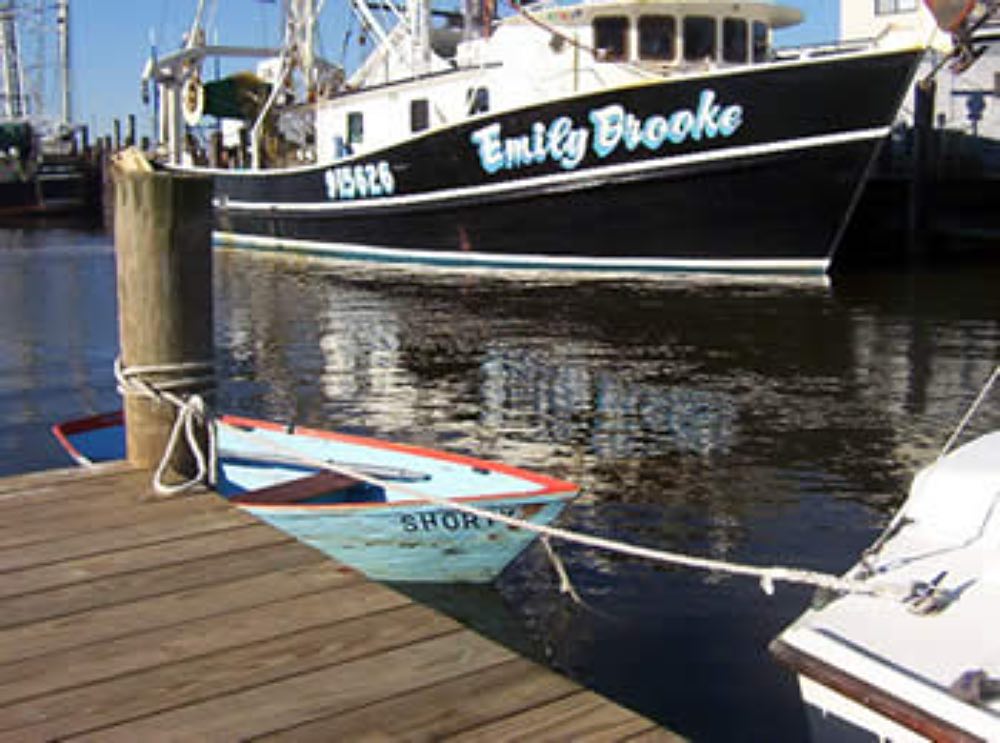
…and a trusty dinghy named “Shorty”.And so they sailed down Long Island Sound, off the Jersey shore, through the Chesapeake on to northeastern NC. Near the Alligator River, they met a sailor in another small sailboat. Kevin Nealey was traveling by himself and the three became friends instantly and decided to travel to Florida together. (Kevin is aiming for Patagonia) The three went ashore near the Pungo. Sitting around a campfire one night, they got to talking about what could be the worst possible thing to happen to a sailboat. Kevin offered that if a mast went on a boat, one of the skinny pines in the woods near them might serve as a stand-in for a mast.
They sailed down the Pungo Canal, to Belhaven. And past Hobucken.
Then on THursday December 11th, they set out across the Pamlico Sound for Beaufort.
It was blowing 25 knots, and they were beating in to the wind. Around quarter to one Esther says, she was down below and Sean ‘up there’ when the worst thing to happen to a sailboat, did.
The mast snapped.
The mast and jib were in the water, shrouds laying limp. Kevin, sailing nearby, came to their aid. Together, they worked the mast back on to the boat, in order to save the rigging. And then they made for the closest port, which was Oriental about 7 miles away.
It was the kind of trial that would test the mettle of crews with years more experience. Esther says that while Sean “has this thing about freaking out” he was “calm and really collected.” And Sean, a few days later, recalled Esther’s resolve. When the mast first broke he says, Esther’s first comment was “I’m not going home.” And both credit Kevin with coming to the rescue.
(As for what caused the mast to break, it’s open to conjecture. The boat is more than 36 years old. Then too, Sean notes, the wind in the foresail — without the main up —- was a strain on the rigging in those conditions.)
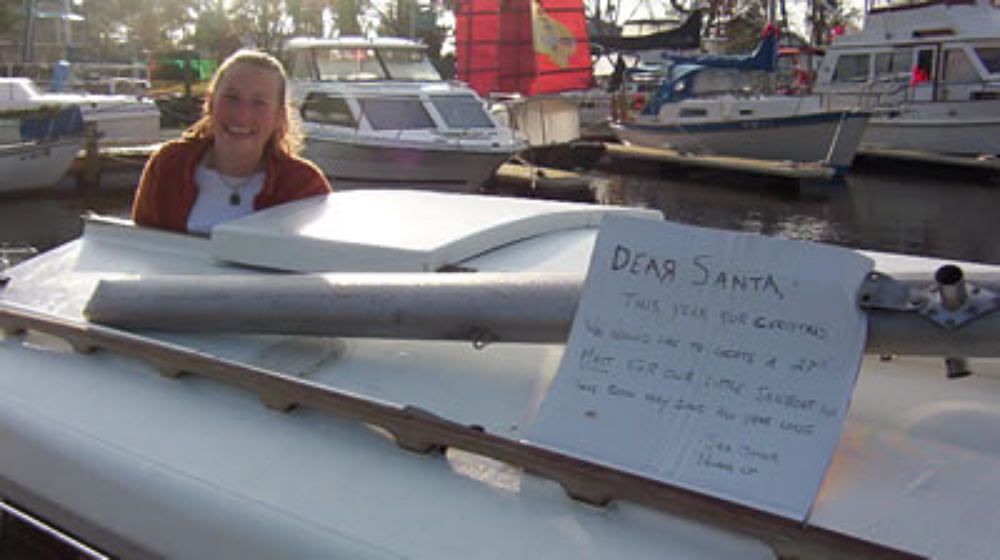
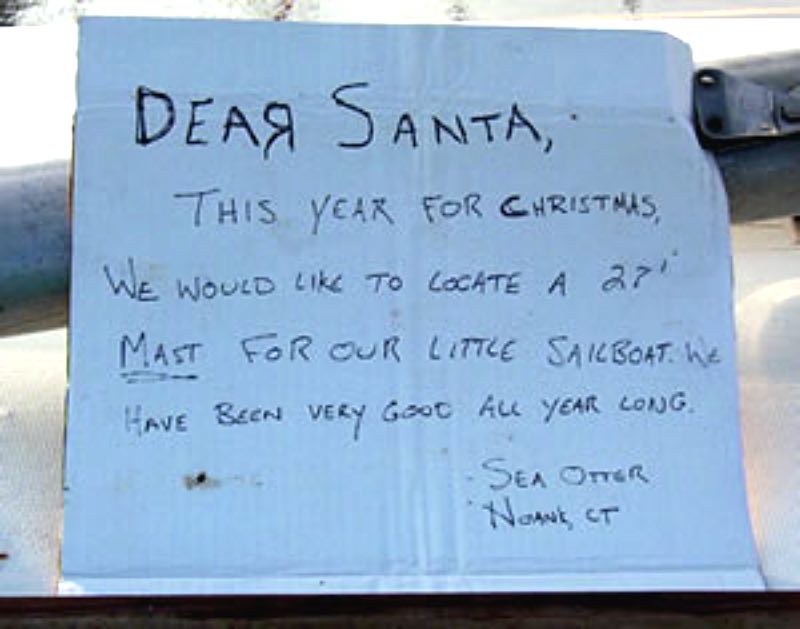
Sean and Esther pulled up to the bulkhead at the Town Dock, and quickly put up a handwritten sign, a plaintive letter of the season asking for a mast.
Within a week, Sean and Esther located a mast that had been in the ‘attic’ at SailCraft Boat Yard. Sean worked off the cost of the mast by doing jobs there, while Esther found work waitressing at Scoot’s (a nutrition major at U-Maine, she said it was the cleanest kitchen she’d seen in a restaurant.) They worked on getting the mast on the boat, with occasional setbacks (In calculating the length of the rigging, Sean learned that the Pythagorean Theorem does not account for spreaders)
Sean and Esther and Kevin remained in Oriental for Spirit of Christmas, Christmas itself, New Years and the running of the dragon. They became regulars at the Sunday afternoon soccer games at the Straight Road field. (Esther had played on the women’s ice hockey team at U-Maine which became apparent on the Pamlico fields.) In short, they became part of town for 6 weeks.
But the pull of warmer climes was strong and with a mast in place they took off with St. Thomas as a destination for Sean and Esther, and Patagonia the destination for Kevin. (More about Kevin coming soon to the Shipping News. Kevin has a fascinating story – but didn’t garner as much attention in the village as he failed to do anything as dramatic as break his mast.)
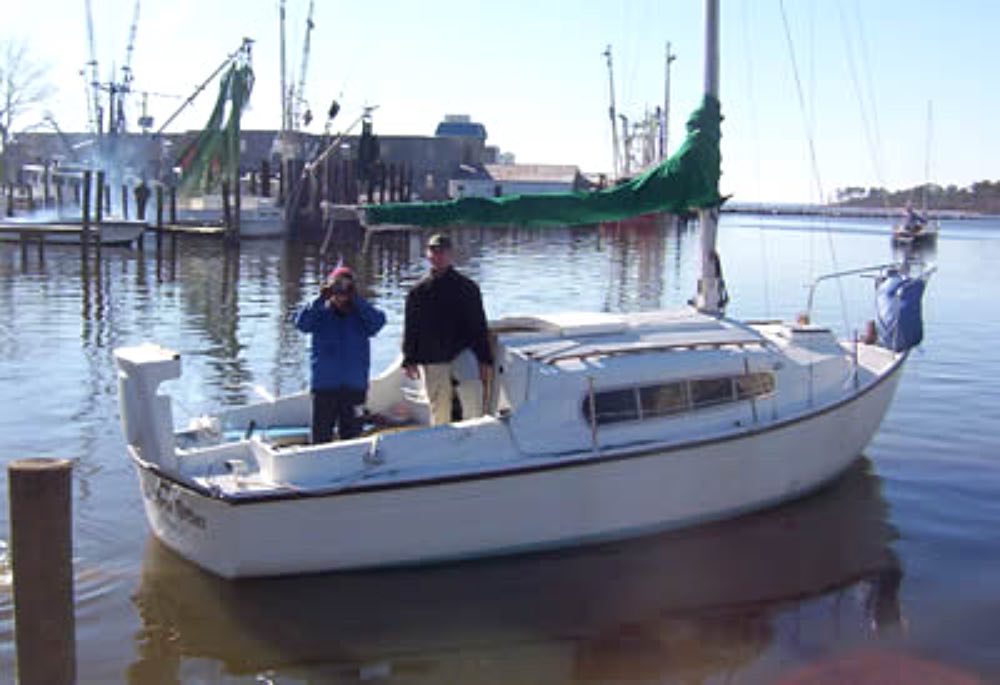 While we take their picture from Town Dock – Esther takes a photo of her own as Sea Otter finally departs Oriental.
Sean and Esther will update their ship’s log here at TownDock.net. Their first dispatch – of the crossing from Wrightsville Beach to Charleston can be found by clicking here.
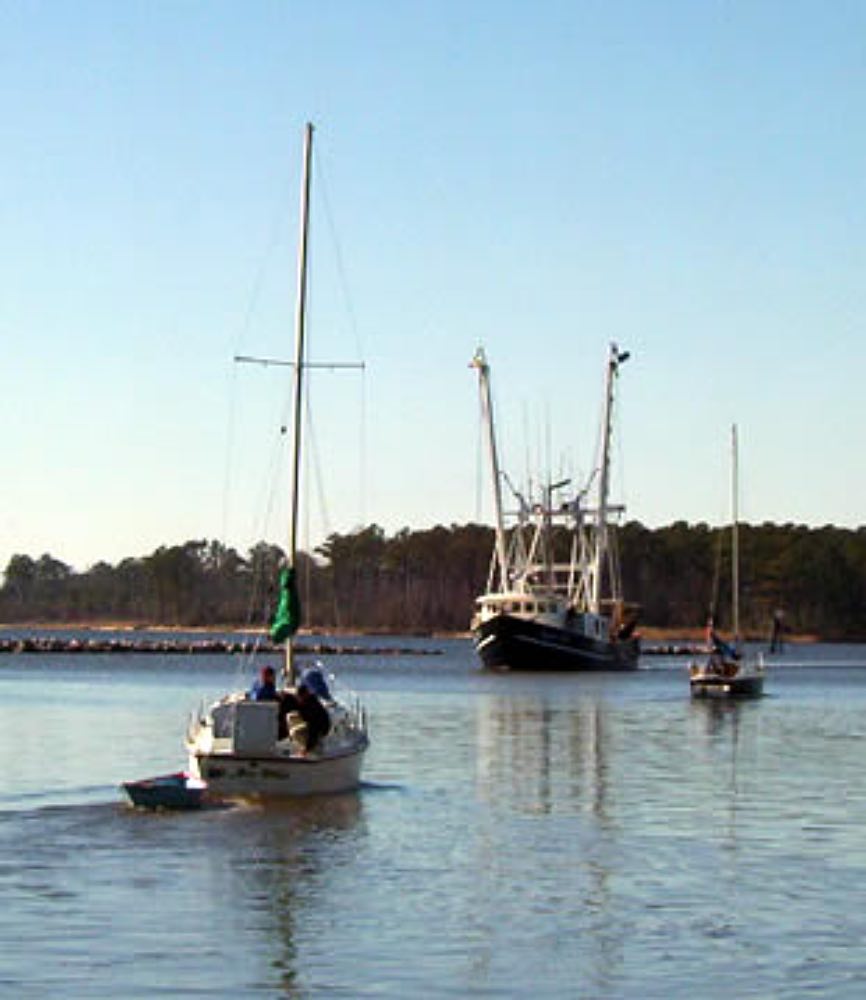 The traveling pair of boats motor out of the harbor.


Posted Thursday February 12, 2004 by Melinda Penkava


 • July 2026 - Marcel Lafond and SV Prospector
• May 2026 - From Argentina to Whortonsville
• February 2026 - Mads and SV Spiffy
• July 2025 - John and the Birds
• July 2025 - Capt. Carl Cannon Jr. & Pirate Ship “Adventure”
• June 2025 - SV Mysto
• March 2025 - 1926 Motor Yacht Mariner III
• January 2025 - SV Skookum Takes On The World
• November 2024 - SV Naia
• March 2024 - Wes Barbour and SV Summer Wind
• December 2023 - Pauline and SV Elektra
• October 2023 - The Coati & The Mermaid
• June 2023 - SV White Seal
• April 2023 - SV Sarah G
• March 2023 - SV Pepita
• February 2023 - S/V Surprise
• January 2023 - SV Thunderstriker
• December 2022 - S/V Capitaine Bontems
• November 2022 - Schooner Huron Jewel
• July 2022 - Ashley, Apache, and SV Friends
• February 2022 - Sam Rouse and SV Nortena
• December 2021 - Coastal Conversations
• February 2021 - Brother Sister Dory Story
• December 2020 - Alan, David Bowie, and Blue 9
• November 2020 - Waiting for the Right Time
• September 2020 - Camping in the Creeks
• August 2020 - Solo Cruiser Emily Greenberg
• June 2020 - SV Mudfog Cove Returns
• March 2020 - SV Beyond
• February 2020 - Shahid & SV Safina
• January 2020 - Electric Vessel with Historic Roots
• May 2019 - SV Misto Circumnavigates
• April 2019 - MV Sea Glass
• July 2026 - Marcel Lafond and SV Prospector
• May 2026 - From Argentina to Whortonsville
• February 2026 - Mads and SV Spiffy
• July 2025 - John and the Birds
• July 2025 - Capt. Carl Cannon Jr. & Pirate Ship “Adventure”
• June 2025 - SV Mysto
• March 2025 - 1926 Motor Yacht Mariner III
• January 2025 - SV Skookum Takes On The World
• November 2024 - SV Naia
• March 2024 - Wes Barbour and SV Summer Wind
• December 2023 - Pauline and SV Elektra
• October 2023 - The Coati & The Mermaid
• June 2023 - SV White Seal
• April 2023 - SV Sarah G
• March 2023 - SV Pepita
• February 2023 - S/V Surprise
• January 2023 - SV Thunderstriker
• December 2022 - S/V Capitaine Bontems
• November 2022 - Schooner Huron Jewel
• July 2022 - Ashley, Apache, and SV Friends
• February 2022 - Sam Rouse and SV Nortena
• December 2021 - Coastal Conversations
• February 2021 - Brother Sister Dory Story
• December 2020 - Alan, David Bowie, and Blue 9
• November 2020 - Waiting for the Right Time
• September 2020 - Camping in the Creeks
• August 2020 - Solo Cruiser Emily Greenberg
• June 2020 - SV Mudfog Cove Returns
• March 2020 - SV Beyond
• February 2020 - Shahid & SV Safina
• January 2020 - Electric Vessel with Historic Roots
• May 2019 - SV Misto Circumnavigates
• April 2019 - MV Sea Glass