
It's Sunday May 31, 2026
September 2, 2008
Oriental is a very walkable town, and now, you can pick up a bit of town history in your wanderings. Oriental’s History Museum has just put out a second self-guided tour. The pamphlets are available at the museum and businesses around town.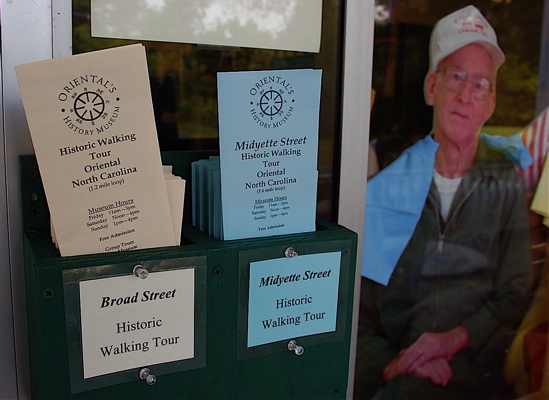 Tours for the taking from the Oriental History Museum. The new walking tour — the blue pamphlet — takes visitors by the site of Oriental’s last sawmill, a house made of bottles and two dozen other places. Red Lee, who looks on in this photo, ran the 25-cent hamburger emporium that was featured in the first walking tour.
The “Midyette Street Historic Walking Tour”, is a 1.6 mile route. It starts at what used to be the gates of the town on North Street, makes its way down Midyette which was central to Oriental’s lumber town past, before looping through other parts of the Old Village.
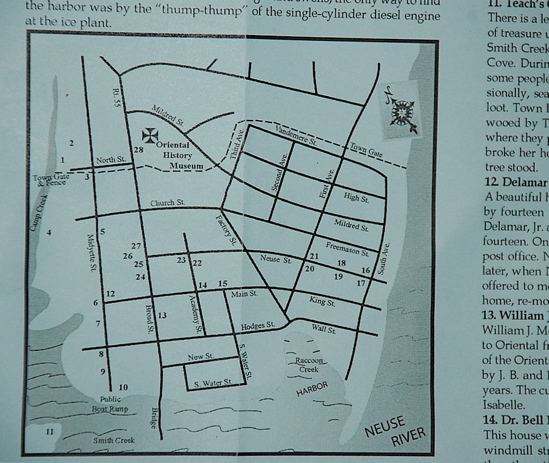 The route the Midyette Street tour takes. As you can see, it goes beyond Midyette.
The tour is not just for tourists. In addition to pointing out places where buildings used to stand, the guide offers some background and lore about buildings we see everyday.
Museum volunteers Bob and Jackie Thompson and Michele Noevere wrote the Midyette Street pamphlet. The printing was paid for by contributions from Village Realty, Century 21 Realty, Tidewater Real Estate, Errands Plus and the Tourism Board. Marsha Shirk says one more tour pamphlet may be produced, with bikers and paddlers in mind.
There are 28 stops on the tour. Here is just a sampling.
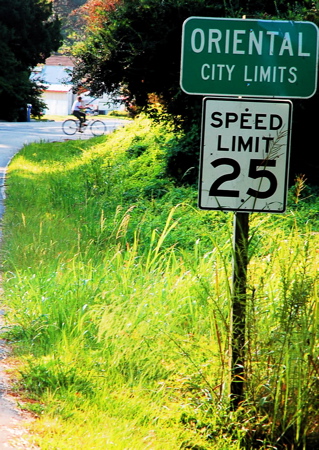 North Street at Camp Creek, where around 1900, a fence was erected, the guide says, to keep roaming cattle out of town. The fence stretched several blocks over toward the Neuse near Vandemere Street.
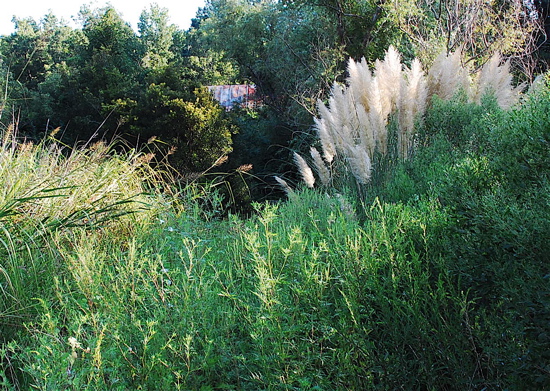 The driveway is overgrown right now, but from North Street and the start of the tour, you can see the metal roof of the John Henry Wiggans home. Wiggans, who was a black contractor, built this home for his own family around 1910.
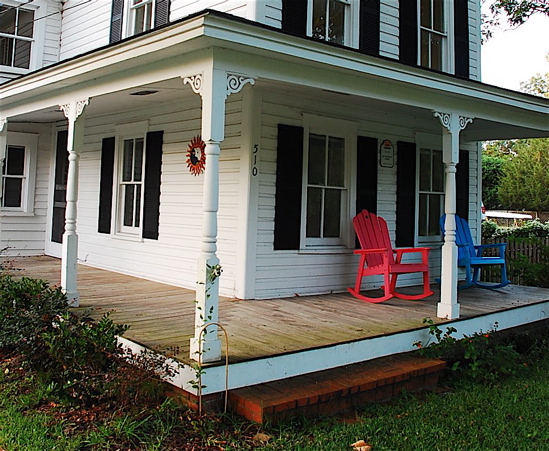 Dr. Peterson House, one of Oriental’s first homes, built in 1878. The physician is said to have also served as a dentist, and was the town’s first mayor in 1899.
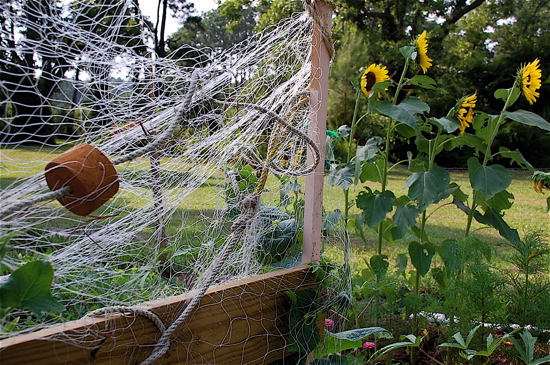 This summer, a garden grew on the large tract of open land on Midyette Street where the town’s last sawmill once stood.
 It’s mostly all field and woods now, but in 1910 Charlie Lewis set up his sawmill here. The Ragan family revived the mill in the mid-forties and ran it until the 1960’s. Then, the guide notes, they focused on building the Oriental Marina as Oriental became popular as a sailing town.
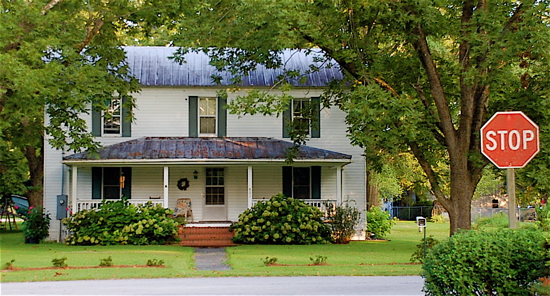 The Dixon House at 501 Midyette, built around 1910.
[page]
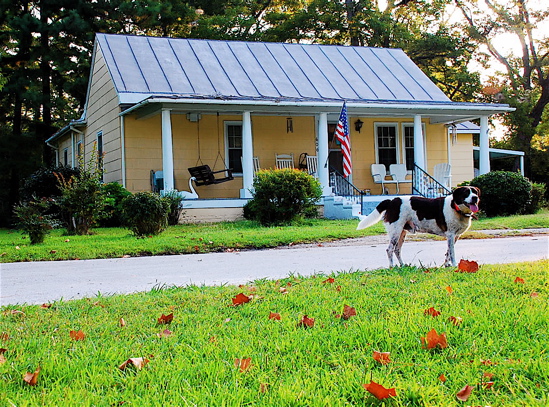 Corner of Midyette and Main and Ned Delamar, Jr’s home, which was moved from another location where it had served as the town’s post office. Those five columns on the front porch were from a larger house that burned at this site in the 1930’s.
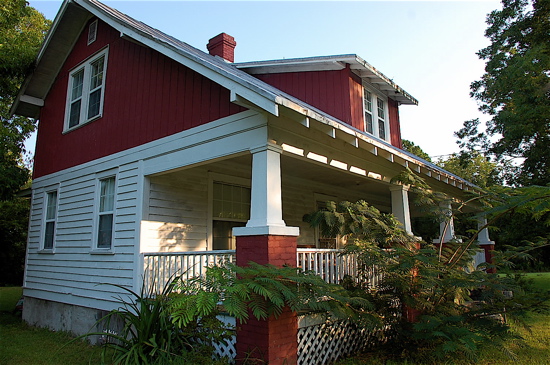 405 Midyette Street, aka, the Willis Sanford House, which is a classic example of the Bungalow style. The guide says that when it was built, around 1925, Midyette Street was only a dirt path with railroad tracks running alongside.
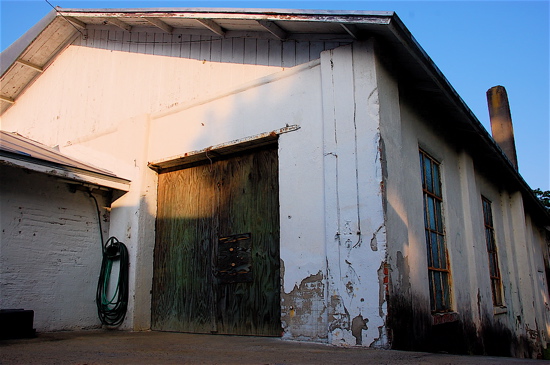 The old Trent Ice Company at Midyette and Hodges Streets. Built around 1920, it made 100 blocks of ice daily in the pre-electric refrigeration times. The diesel-powered plant also put out a distinctive ‘thump-thump’ sound, a sound which, the guide says, at least one man used to navigate his sailboat back to town at night in the 1930’s.
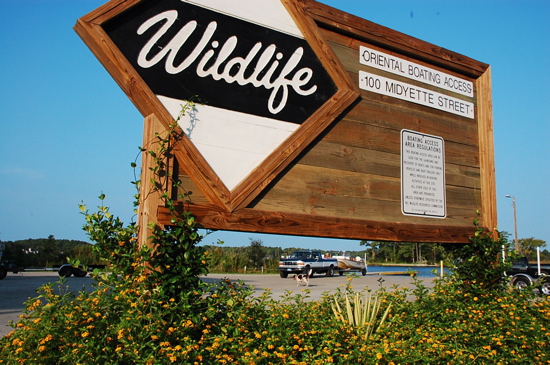 The end of Midyette Street, an area familiar to those who launch boats at the NC Wildlife Commission’s ramp. Back at the turn of the last century, when lumber mills hummed on both sides of Smith Creek, and a railroad ran parallel to Midyette Street, this was the turnaround area for the trains.
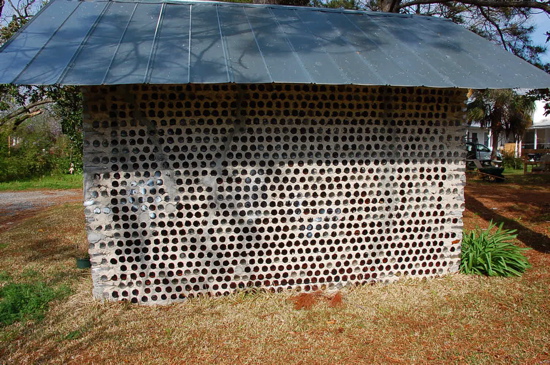 Number 26 on the tour is one of Oriental’s odder structures, The Bottle House. According to the guide, Branch Hodges built this shed-sized building around 1951, using only beer bottles and cement. He was an ‘“early recycler,” says Marsha Shirk of the history museum.
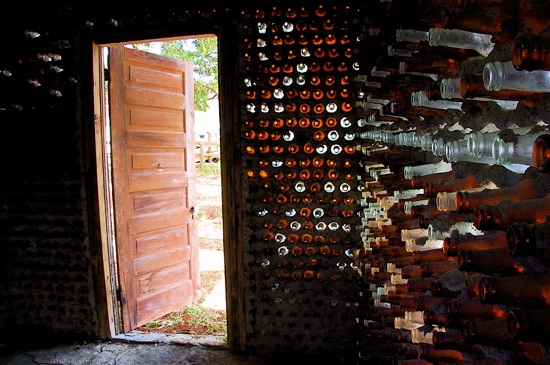 Inside the Bottle House. Research found that Mr. Hodges himself did not drink. Marsha Shirk says he got his bottles from a local bar — thought to be the Wit’s End — where the the beer selection consisted of Pabst and Miller. Those are the only brands used for this building and would explain its two-tone pattern. You can see it behind A Different Twist at 509 Broad.
[page]
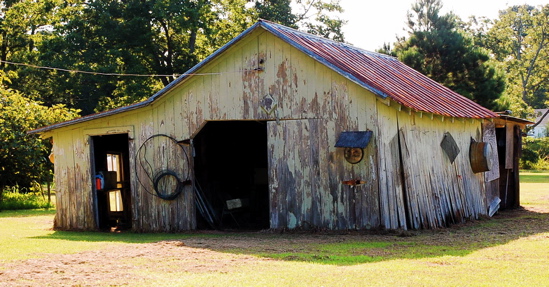 The shed behind #22 on the tour, the Graden Barker House which was built in 1883, making it one of the oldest in town.
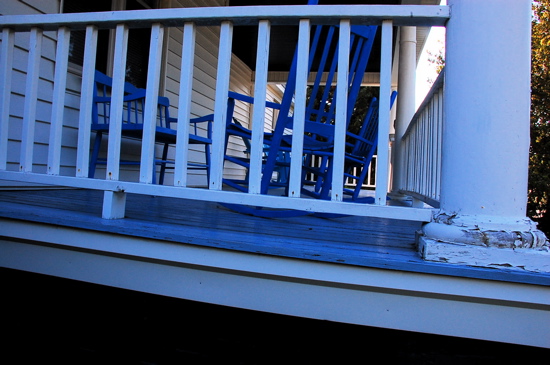 Perhaps the bluest chairs on the tour are to be found at the Dr. Bell House at Academy and Main. Among the medical challenges he faced was a smallpox epidemic in town in 1911. The guide says the property at one time had a two-story windmill with water tower.
Whether you take the tour, or are just walking around town, you may be seeing more and more of the historic plaques and markers put out by the museum’s Friends of Oriental’s History.
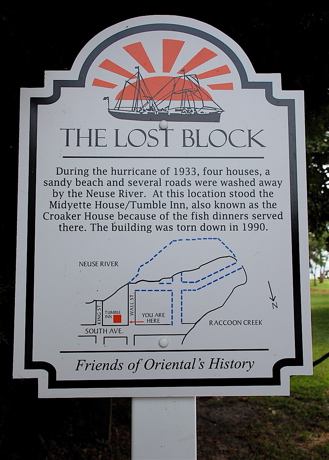 The Lost Block Marker at Wall St and South Avenue.
Since the spring when the museum started this program 9 markers and 12 house plaques have been sponsored. A grant from the Pamlico County Community Foundation provided the startup funds for the project but private contributions are needed. The house plaques cost $80 and the markers are $120. The Oriental Museum has applications at the museum. For more info, call Marsha Shirk at 670-9318 or Sharon Breitling at 249-3340.
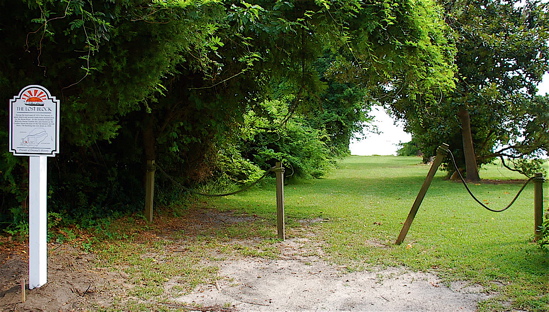 South Avenue and Wall Street where it extends — grassily — to the edge of the Neuse. That public access street is one of the sites in town now marked with an historic marker from the Friends of Oriental’s History.
Posted Tuesday September 2, 2008 by Melinda Penkava

 • May 2026 - The Pig Celebrates 10 Years • May 2026 - NOAA's Prediction: A Below Average Hurricane Season • April 2026 - Cycle NC 2026 • April 2026 - April Town Board Meeting 2026 • April 2026 - Zac Schnell, AI and Community Engagement • April 2026 - The 2026 Oriental In-Water Boat Show • April 2026 - Eston “Sherrill” Styron, 1942 - 2026 • April 2026 - Capsizing on the Creeks: SailPack 2026 • April 2026 - 2026 PAWS Pet Parade • March 2026 - The Dragon Burn That Didn't • March 2026 - James "Jimmy" Edward Ragan, III, 1941 - 2026 • March 2026 - March Town Board Meeting 2026 • March 2026 - Loblolly Pines & Pollen • March 2026 - Russell "Russ" Bryan Stevenson, 1932 - 2026 • March 2026 - Town Board Acts Fast in Fight for Funds