
It's Monday October 12, 2026
News From The Village Updated Almost Daily

August 31, 2026
As best as I can piece it together, a group of influential state senators from the Charlotte area, came to the conclusion that if they have to pay tolls to take the express lanes on I-77 around Charlotte, then everyone in Eastern North Carolina should have to pay a toll to ride a ferry. This seemed to be the case in 2023, when Senator Vickie Sawyer (R-Iredell) last led the effort to levy a ferry toll.
I don’t believe they did much of an economic impact study to come to this conclusion. I just think they were mad. Indeed, the State Auditor is preparing a review of the Ferry Division, to be delivered January 2027 – after the tolls are set to begin.Greg PinerRegardless of their motive, it is now the law of the land that: “The Board of Transportation in consultation with the Ferry Division shall establish tolls on all ferry routes.”
All of the revenue from the tolls will go to the Ferry Capital Special Fund, solely to help fund the purchase of new ferries. I have heard that the goal is to raise $5 million of gross revenue each year. Five million.
Three of the seven vehicle transport ferries are already toll ferries. The remaining four vehicle ferries are to begin tolling in January 2027.
The state of North Carolina has some very efficient ways to raise revenue.
Tolling ferries is not one of them.
The Ferry to Ocracoke – Hatteras, the only way to travel to and from the island, will now require residents to purchase a pass to reach their homes.Tolling Ferries is Very InefficientCollecting tolls is labor intensive and has a huge overhead. A reasonable estimate is that for every dollar you spend on a ferry toll, fifty cents goes to the cost of taking your money.
That’s not just true for North Carolina, it’s that way all across the country.
The entire North Carolina Ferry System transports around one million vehicles each year. Currently the three ferry routes in North Carolina that are tolled generate about $2 million of gross revenue each year. The overhead to generate that revenue is about $1 million – half of the revenue generated. The four remaining ferry routes will require millions of dollars to provide the infrastructure necessary to begin tolling vehicles.
That $5 million number is deceptive. Taking in the tolls will cost the Ferry System about $2.5 million to implement and maintain. The result: only $2.5 million is actually raised.
Tolling ferries is a very, very bad way to raise revenue.
Kinnakeet Ferry leaves the dock at Minnesott, loaded with vehicles.An Efficient Way to Raise RevenueYou might not like to pay it, but the gas tax is efficient. For every dollar you pay in gasoline tax, (the average driver pays around $350 a year) 95 cents goes straight to the Department of Transportation to do the things they do.
One of the things they do is fund the North Carolina Ferry Division. On the Neuse and Pamlico Rivers, the ferry routes are our highways. We take them to our jobs, to school, to business appointments, doctors visits, to visit family, to run errands. Now those ferry routes – our highways – are about to become toll roads.
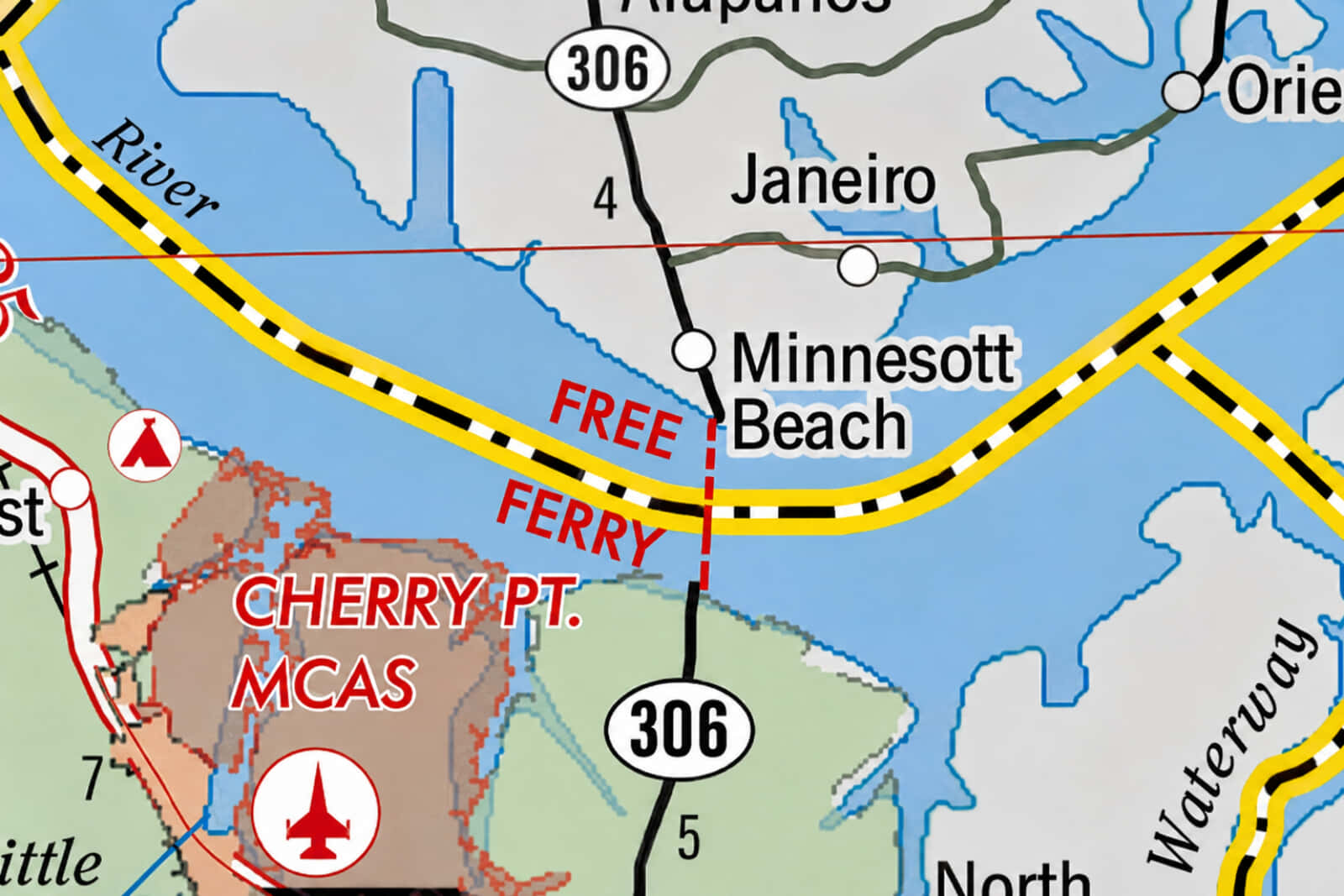
Ferries are part of the highway system. For example, the Cherry Branch – Minnesott Beach Ferry is a continuation of Highway 306.The gasoline tax provides the DOT about $2.4 billion each year. The current gasoline tax is 41 cents per gallon. There are roughly 7 million people all over the state just pumping away. Every time a gallon of gas goes into their tanks, 41 cents goes to the State gas tax fund.
When you get all those people pumping all that gas you can generate a lot of revenue. How much revenue? One cent of gas tax generates $53 million per year.
The 72 cent SolutionWhat if someone told you that if the state of North Carolina raised your gasoline tax from an average of $350.00 each year to $350.72 each year, then $5 million of revenue could be put in the North Carolina Ferry System Fund every year, and ferry tolls could be completely eliminated on all the ferries in North Carolina?
That would allow the Ferry System to focus on what they are trained to do: safely transport as many vehicles as possible every day across the rivers and sounds of North Carolina.
That is what generates real revenue, revenue for small businesses, restaurants, hotels, and the thousands of local citizens that take a ferry to go to work.
A simple one-tenth of a cent gas tax will generate far more revenue than a ferry toll ever could.
Greg Piner
Oriental, NCRelated Information• 2023: Fighting the Ferry Tax. Again.
• 2013: Guest Column: The Cost of Ferry Tolls
• 2013: Fight Renewed Against Ferry Tolls
• 2012: Governor Purdue Stops Ferry Tolls
• 2012: How Pamlico County Got Stuck with Ferry Tolls




 • October 2026 - A $90 Gift Can Make a Difference for Hope Clinic
• August 2026 - The Ferry Problem: A 72 Cent Solution
• April 2026 - Weekend Preview: Sailpack 2026
• November 2025 - Dredging Starts Soon
• April 2025 - Seeking STEM Speakers
• December 2024 - Jimmy, Millard and Sam built some houses
• April 2024 - Sailpack 2024 This Weekend
• April 2023 - Join Sailpack, and keep the Regattas In Oriental
• April 2022 - Collegiate Regatta & A Pig Pickin'
• April 2022 - 2022 Holy Week and Easter Celebrations in Oriental
• February 2022 - Mardi Gras, Shrove Tuesday, Ash Wednesday
• January 2022 - I Have A Dream
• October 2026 - A $90 Gift Can Make a Difference for Hope Clinic
• August 2026 - The Ferry Problem: A 72 Cent Solution
• April 2026 - Weekend Preview: Sailpack 2026
• November 2025 - Dredging Starts Soon
• April 2025 - Seeking STEM Speakers
• December 2024 - Jimmy, Millard and Sam built some houses
• April 2024 - Sailpack 2024 This Weekend
• April 2023 - Join Sailpack, and keep the Regattas In Oriental
• April 2022 - Collegiate Regatta & A Pig Pickin'
• April 2022 - 2022 Holy Week and Easter Celebrations in Oriental
• February 2022 - Mardi Gras, Shrove Tuesday, Ash Wednesday
• January 2022 - I Have A Dream